
Industrial Lost Wax Casting for Complex Metal Parts
Industrial lost wax casting, also called lost-wax investment casting, uses a disposable pattern to create a ceramic mould for a metal part. It is useful when complex geometry, integrated features or reduced assembly are more important than a simple moulding route. The final choice depends on alloy, section thickness, quantity, machining and service conditions.
Lost wax casting in an industrial context
Industrial sourcing is different from jewelry or art casting. The buyer needs a controlled drawing, material decision, repeatable route, finishing plan and acceptance criteria. A process description should explain the relationship between pattern, shell, pour, cut-off, cleaning and inspection without turning a handbook sequence into an unverified supplier promise.
The pattern-to-part timeline
- Review the part drawing, model, datums, radii, holes and machining surfaces.
- Prepare the die or pattern strategy and account for material and process shrinkage.
- Assemble patterns into a cluster and plan gates, supports and ceramic access.
- Apply slurry and stucco coats with drying between stages to build the shell.
- Dewax and fire the shell before pouring the selected metal.
- Remove the shell, cut off the casting, clean the surface and complete agreed finishing.
- Inspect the specified characteristics and compile the records required by the order.

The photograph shows stacked rectangular open-grid furnace baskets on the factory floor. It illustrates product geometry, not the wax pattern, shell binder or finishing operation.
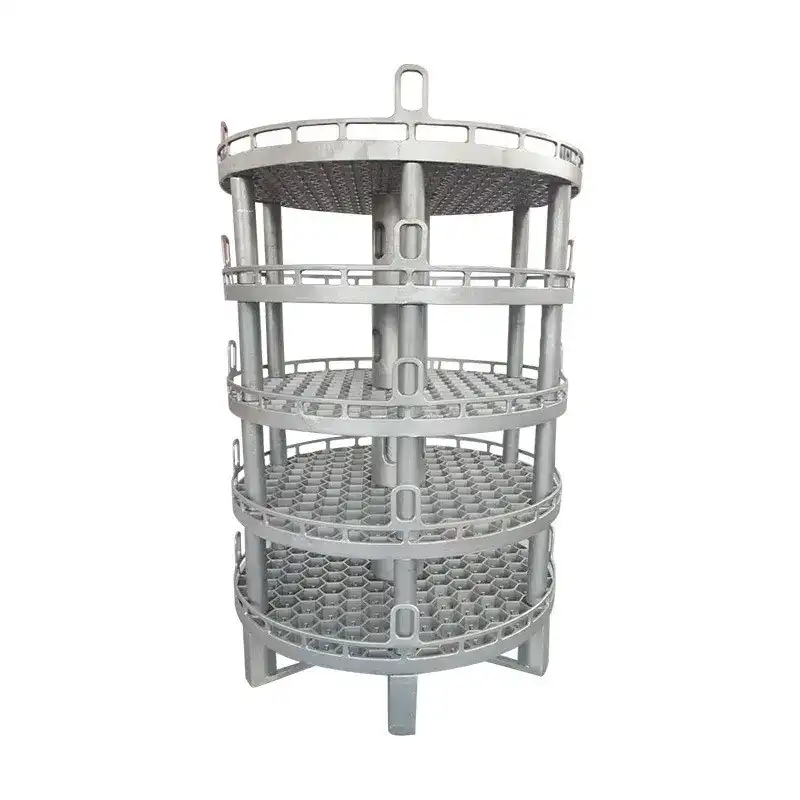
The photograph shows cylindrical multi-level heat treatment tooling. It is a product reference, not a step-by-step process diagram.
Where the process adds value
Lost-wax investment casting is worth considering when the part has several integrated features, curved transitions, repeated bosses, internal openings or a shape that would otherwise need fabrication and joining. It may also be attractive for custom furnace hardware when the drawing benefits from a near-net-shape route. Confirm section thickness, ceramic removal access and machining references before committing.
Design questions for a quotation
| Feature | Review question | Why it matters |
|---|---|---|
| Holes and passages | Can the pattern and shell be removed or cleaned reliably? | Access and residual-material risk |
| Ribs and corners | Are radii and transitions defined? | Pattern filling and local stress review |
| Machined faces | Which surfaces need stock? | Datum and finishing planning |
| Gates and supports | Where can they be placed? | Cut-off, cleaning and service impact |
| Quantity | Is the route for samples or recurring parts? | Pattern and process economics |
Defects and prevention questions
General pattern-control guidance links dimensional variation to die condition, pattern shrinkage, pattern temperature, hold time and die-making temperature. Other pattern issues can involve filling, pressure, venting, gates and parting-agent use. Use these as review prompts; they do not guarantee defect-free output or a specific casting tolerance.
Lost wax versus sand casting
Lost wax generally places more emphasis on disposable patterns and ceramic shells, while sand casting uses a pattern and granular mould system. Geometry, size, volume, tolerance needs, surface expectations and machining plan determine the practical choice. Compare this page with the sand-casting alternative and discuss the drawing with an investment casting foundry review.
Industrial lost wax casting FAQ
Is industrial lost wax casting only for small parts?
No single size rule applies across all foundries and geometries. Discuss envelope, weight, section thickness, handling and the required evidence with the supplier for the actual drawing.
Does lost wax mean the final part contains wax?
No. The wax or other expendable pattern is removed before the shell is fired and metal is poured. The pattern is a temporary tool for forming the cavity.
Can lost wax remove all machining?
No. Some surfaces may be near-net shape while datum faces, fits, holes or critical features may still require machining. Mark the required surfaces on the drawing.
How can I avoid confusing industrial and jewelry results?
State the industrial alloy, part function, drawing revision, quantity, furnace or process application and documentation needs. Ask for evidence relevant to the component rather than generic casting photographs.
RFQ checklist for industrial lost wax parts
Send the drawing and model, pattern or tooling status, material or service condition, quantity, critical dimensions, holes and passages, machining surfaces, surface requirements, inspection criteria, documentation, packaging and delivery destination. Include photos and failure history when replacing an existing furnace component.
Manufacturing and Product Evidence


For a project review, send your drawing, sample photos, furnace conditions, quantity and inspection requirements through our Contact Us page.


 +44 7419 144346