
Adding a level to a tray stack increases the load carried by the parts below, even when the taller assembly clears the furnace door. Review every grid, post, spacer and workpiece as part of one assembled load. The checks below help you document the load path, effective stack height and transfer supports before requesting approval for the new configuration.
A taller batch changes more than the top clearance
For a hypothetical change from two working levels to three, record the extra grid mass, its payload and the added support interfaces. Show the new load positions on the transfer drawing as well as the furnace drawing.
Start with a side elevation and a plan view. Number the base and every working level. Identify the actual contact surfaces between levels, and distinguish load-carrying seats from features that only locate a post. A pin entering a hole does not, by itself, show which shoulder carries the weight.
Cronite’s base-tray overview distinguishes base trays, intermediate grids and baskets as different components of furnace loading systems. That industry context supports reviewing the assembly; it does not establish the loading capacity of an ECOOSUN design.
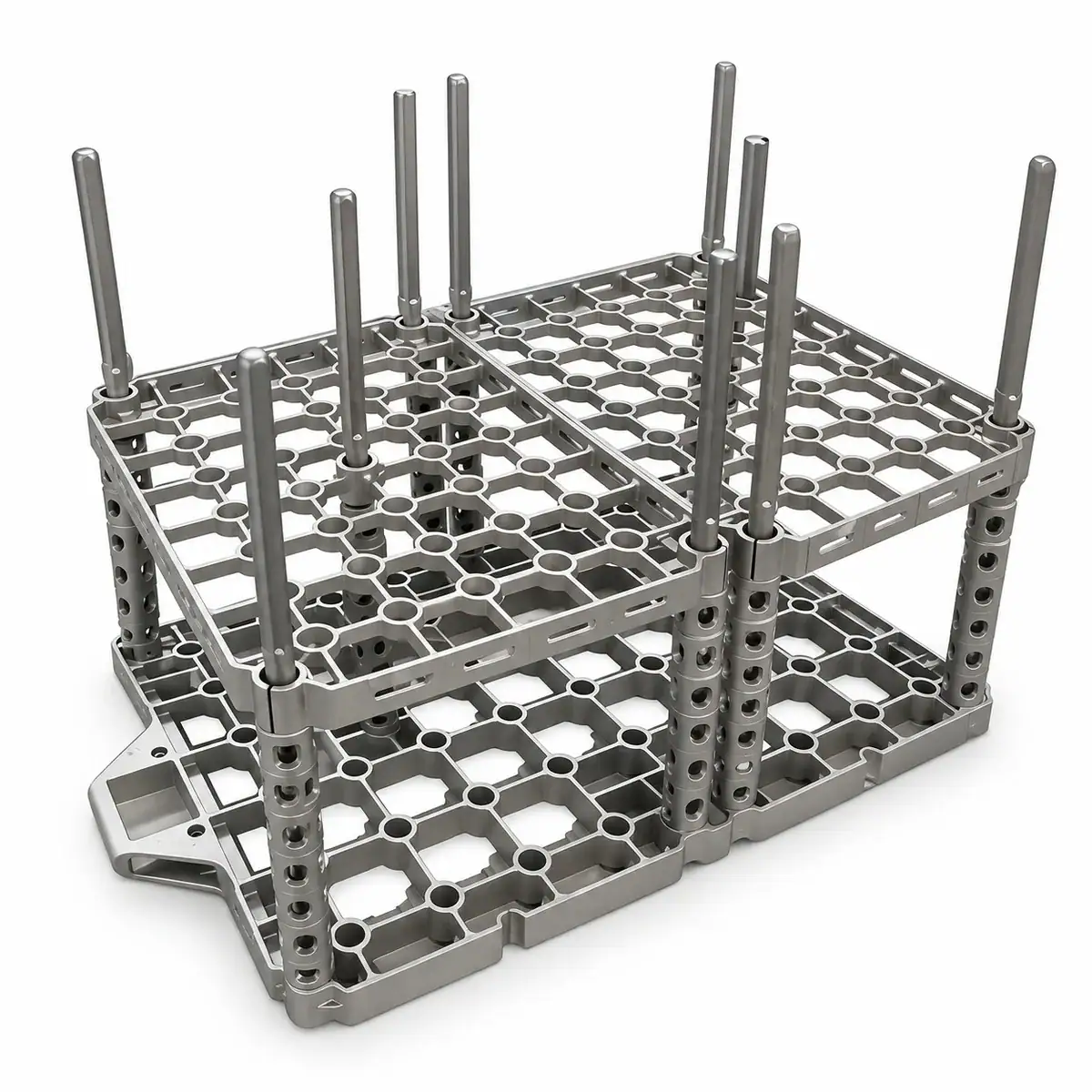
Trace the weight down to the furnace support
For each interface, list everything supported above it: workpieces, grids, separators and the relevant posts or sleeves. The base must be reviewed for the complete assembly and payload. List fixture mass and product mass separately, then state their combined total so the quotation accounts for both.
Do not divide the total weight by the number of feet and treat that answer as a verified reaction. Uneven loading, different seat heights and the stiffness of the assembled parts can change how the weight is shared. Show off-centre workpieces and empty positions. The engineering reviewer needs the intended loading arrangements, including the least balanced permitted arrangement.
Repeat the map for lifting and transfer. Forks beneath the base may support different locations from furnace rails. A stack that sits acceptably at rest still needs review while entering, stopping, changing support or being unloaded.
Complete a stack-level review sheet
Complete one sheet for each proposed stack configuration and link each row to its drawing or record. Mark missing values as unresolved. This worksheet organises the review inputs; it does not calculate or certify load capacity.
| Position or stage | Record on the assembly | Load-path question | Release evidence |
|---|---|---|---|
| Top working level | Workpieces, local grid mass, part positions | Where does this level deliver its weight? | Marked contact map and level ID |
| Each intermediate level | Own contents plus all supported levels above | Do seats bear on intended posts or structural ribs? | Seat locations and accumulated supported mass |
| Lowest posts or stacking feet | Member IDs, effective heights, contact condition | Which reactions reach each foot; are any contacts missing? | Engineering review of actual support distribution |
| Base tray | Complete fixture mass and payload | How does the base bridge the furnace supports? | Approved support layout and loading drawing |
| Assembled height | Bottom support datum to highest loaded feature | Do nested seats change effective level spacing? | Measured assembly and agreed envelope |
| Loading and transfer | Fork, lift or conveyor contact positions | Does temporary support change the load path? | Handling arrangement reviewed for this stack |
| Heating and cooling | Cycle, atmosphere, material records, exposed passages | Where could movement become restrained? | Application-specific thermal and process review |
| Return and reassembly | Component IDs and orientation at every level | Could an incorrect post or spacer alter the next stack? | Assembly instructions and identification check |
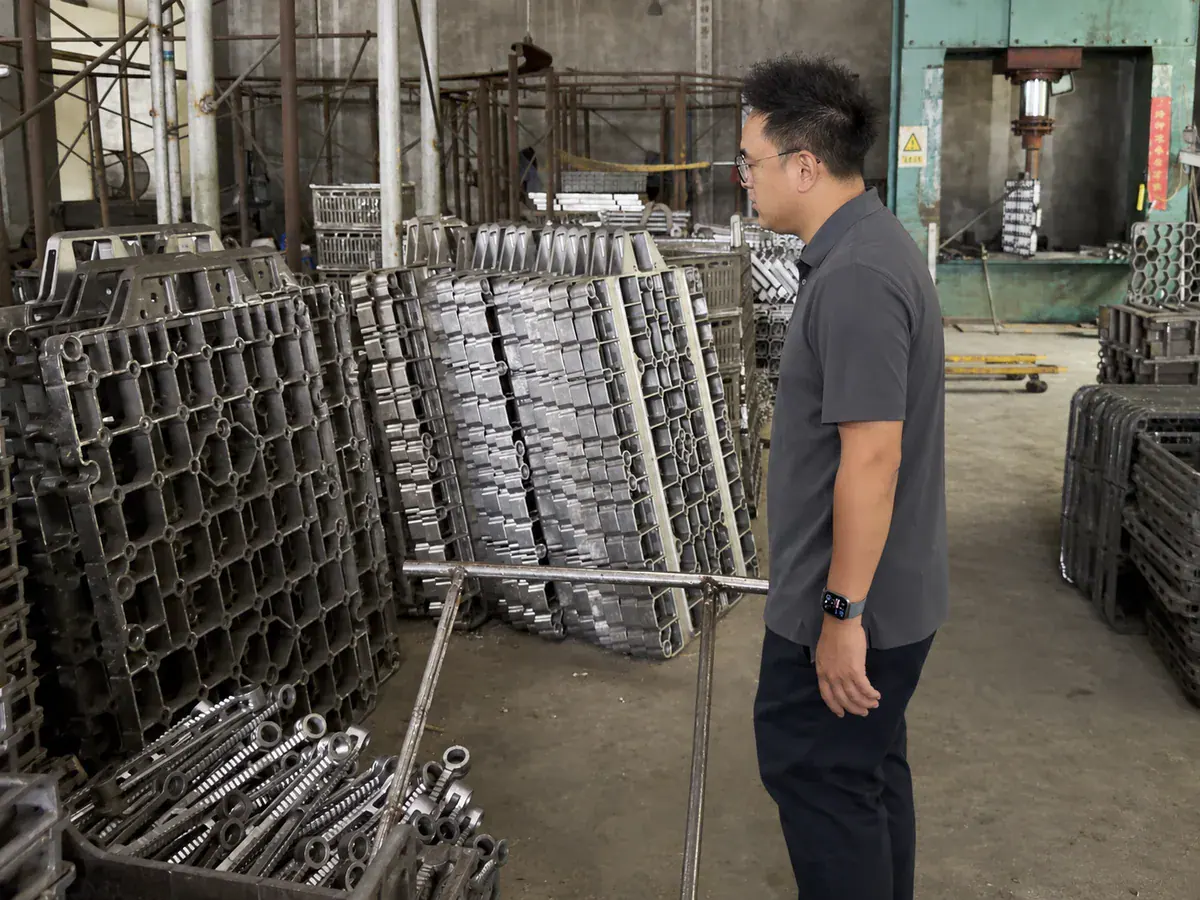
Measure assembled height from a functional datum
Define the bottom reference as the surface that actually rests on the furnace support. Measure to the highest feature in the loaded assembly, including protruding workpieces and handling hardware that travels with it. Record the individual clear spaces between levels as well as the overall height.
Use the assembled geometry instead of simply adding catalogue heights. A post may enter a socket, a shoulder may establish the working level, and a sleeve may overlap a grid. Those details determine effective height. Check the loading door, transfer station and unloading equipment as well as the chamber.
The cold measurement is a baseline. Thermal movement, service distortion and the proposed process must be assessed separately. A generic expansion gap or maximum number of levels cannot be transferred from another tray design.
Release a named configuration
The output should identify the assembly revision, permitted level count, component combinations, payload arrangement and handling route. Ask the process owner to review circulation and access around the loaded parts; an open grid alone does not demonstrate acceptable heating or cooling throughout a dense stack.
If a level, post height or loading pattern changes, record that change against the configuration. Keep the first assembled measurement as a baseline for later inspection rather than treating the stack as an interchangeable collection of loose castings.
Buyer questions
Can I add a level if the furnace door still clears it?
Door clearance is only one check. Reassess accumulated loading, support reactions, transfer stability and the process implications of the changed arrangement.
Should every layer carry the same quantity of parts?
Not necessarily. Specify the permitted pattern for each level. A review based on equal layers does not automatically cover a different or partly empty arrangement.
Can loose posts be substituted with the same nominal height?
Check their seats, engagement, effective assembled height and material specification. Equal overall length does not establish the same support function.
What should the supplier confirm in the quotation?
Ask for the assembly reference, included components, design assumptions, required buyer inputs and proposed inspection scope. Keep any unresolved loading approval explicit.
Prepare a stack-specific enquiry
Before ordering ECOOSUN heat treatment trays, assemble the numbered stack drawing, per-level loading sheet and transfer support map. Submit them through Contact Us and ask the quotation to identify the proposed configuration, included components and any loading questions still awaiting project approval.
Worksheet and Related Heat Treatment Tray Resources
Download the editable CSV worksheet
Original buyer worksheet. Record project-specific values and approvals; the template does not establish equipment limits or product performance.
Technical references
Sources provide technical context, not endorsements of ECOOSUN. OEM-specific claims and standard scopes are not universal product specifications.

 +44 7419 144346