
Stainless Steel Investment Casting for Industrial Parts
Stainless steel investment casting uses a disposable pattern and ceramic shell to make complex metal components with fewer assembly joints. For industrial buyers, the correct choice depends on corrosion exposure, furnace atmosphere, thermal cycling, geometry, machining stock and quantity. A drawing-led review connects the material question with the actual service condition.
What buyers mean by stainless steel investment casting
The phrase can describe stainless lost-wax castings, custom stainless components or a stainless casting foundry reviewing a supplied drawing. The process is attractive when a part has curved passages, integrated ribs, repeated features or a shape that would otherwise require several fabricated pieces. The selected alloy and shell route still need confirmation for the specific part.
Material and service-condition matrix
| Buyer input | Why it matters | What to provide |
|---|---|---|
| Atmosphere | Oxidizing, carburizing, reducing or mixed atmospheres change the material decision | Furnace atmosphere and process chemistry |
| Thermal cycle | Heating rate, dwell and cooling can drive distortion or cracking risk | Cycle description and operating range |
| Load and support | Creep, sagging and contact stresses depend on geometry and loading | Load direction, support points and fixture layout |
| Corrosion exposure | Moisture, salts and process gases can change surface degradation | Gas, residue and cleaning information |
| Geometry | Thin sections, holes, ribs and radii affect pattern and shell design | Controlled 2D/3D drawing and critical dimensions |
How the casting route is selected
General investment-casting guidance describes a sequence that includes die and pattern preparation, cluster assembly, slurry and stucco coats, drying, dewaxing, shell firing, pouring, shell removal and finishing. For a real quotation, each stage should be matched to the supplied geometry and acceptance criteria rather than copied as a universal promise.
- Review the drawing revision, datum scheme and critical-to-function features.
- Record atmosphere, temperature range, load, thermal cycle and expected contact conditions.
- Compare stainless and heat-resistant alloy families against the service environment.
- Select a casting route and identify gates, supports, machining stock and inspection points.
- Confirm material records, finishing requirements and quotation assumptions in writing.
Geometry, finish and machining questions
Investment casting can reduce part count, but it does not remove the need for design-for-manufacture review. Pay particular attention to internal passages, sharp transitions, isolated heavy sections, trapped ceramic, datum accessibility and surfaces that will be machined after casting. Handbook values for accuracy or roughness are general engineering references only; they are not ECOOSUN guarantees.
Useful design questions include:
- Which dimensions are functional and which are machining references?
- Which holes must remain open after shell removal and cleaning?
- Where can gates or supports be placed without affecting service?
- Which surfaces need stock for turning, milling or grinding?
Industrial applications to review
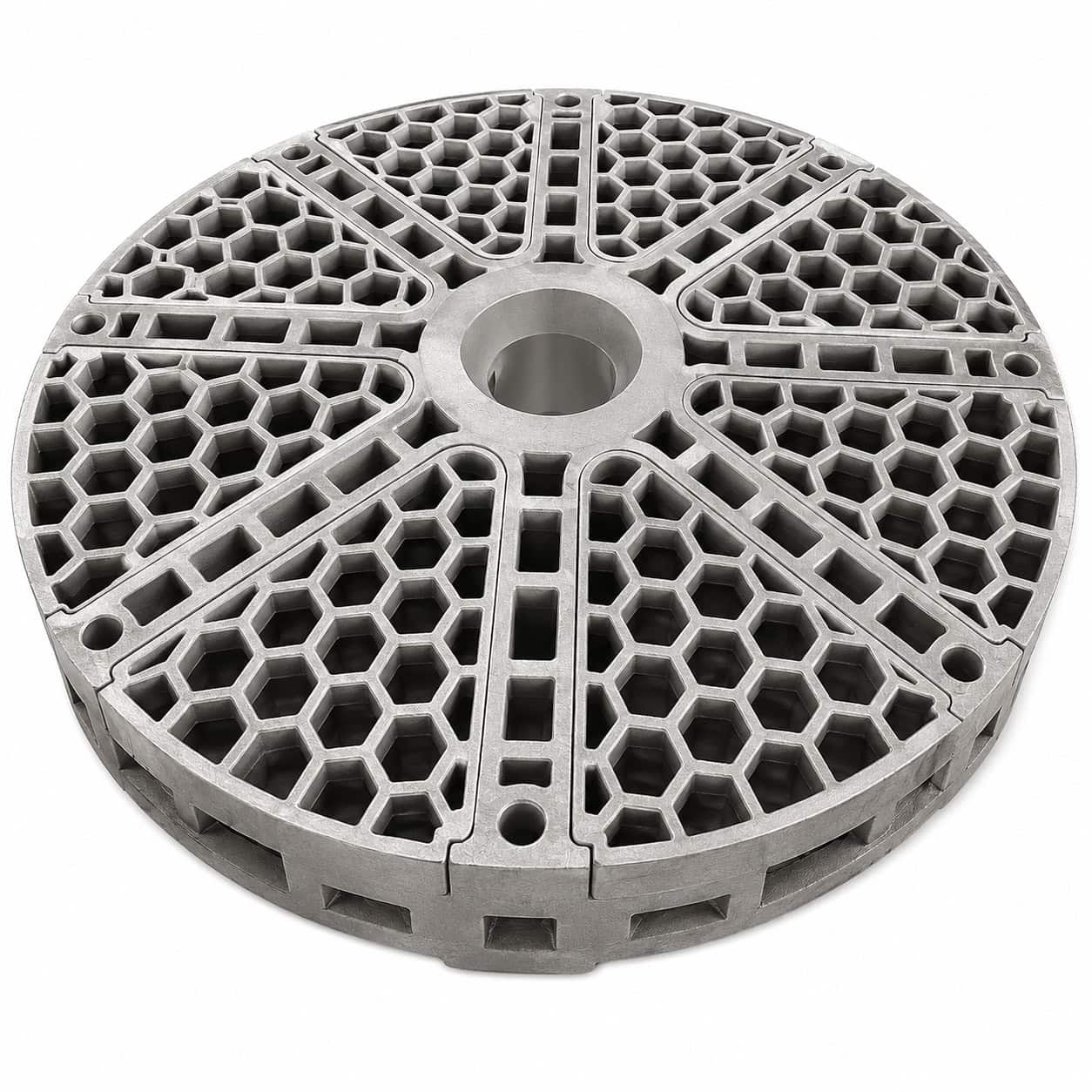
Stainless castings may be considered for furnace fixtures, charging hardware, brackets, impellers, wear components and other industrial parts where the geometry and environment justify the route. The product category should be selected from the service condition, not from the alloy name alone. See related heat-treatment fixtures and furnace internals when the part operates inside a thermal-processing line.
The photographed impellers show finished metal geometry only; the image does not verify stainless grade or casting method.
Quality records and quotation checkpoints
Before any capability statement is made, agree on the evidence needed for the order. Depending on the drawing and buyer specification, the review may cover material identification, dimensional inspection, visual acceptance, heat-treatment records or other documentation. The exact inspection scope, method and acceptance criteria must be confirmed for the part.
This image shows a measurement workstation. It does not identify a specific NDT method or certify a result.
Stainless steel investment casting FAQ
Is stainless steel investment casting the same as stainless steel lost wax casting?
In industrial sourcing, the phrases often describe the same expendable-pattern family. Ask the supplier to state the pattern, shell, pouring and finishing route for the specific component.
What stainless grade should I specify?
Start with the actual atmosphere, temperature range, load, corrosion exposure and drawing requirements. If a grade is already specified, include the applicable material document and acceptance criteria; otherwise request an engineering comparison rather than choosing from a catalogue name alone.
Can a product photograph prove the alloy?
No. A photograph can show visible geometry and surface appearance, but it cannot prove chemistry, grade, casting route, certification or inspection method. Those points require controlled records.
What quantity information helps a quotation?
Provide prototype quantity, expected recurring quantity, delivery pattern and any packaging or traceability requirements. The production route and commercial assumptions should be confirmed after drawing review.
RFQ checklist for stainless cast parts
Send the latest drawing or 3D model, requested material or service condition, operating atmosphere, temperature and thermal cycle, load and support details, quantity, machining requirements, critical dimensions, inspection expectations and documentation needs. For a supplier review, the investment casting foundry guide explains the information used to compare a foundry response.
Manufacturing and Product Evidence


For a project review, send your drawing, sample photos, furnace conditions, quantity and inspection requirements through our Contact Us page.


 +44 7419 144346