
Silica Sol Investment Casting for Precision Industrial Parts
Silica sol investment casting uses a water-based colloid of very fine amorphous silica particles as a shell-binder system. It is considered when the buyer needs a controlled ceramic shell for complex industrial geometry and close attention to surface quality. Final accuracy, finish, alloy and inspection scope remain drawing- and record-dependent.
Why buyers consider a colloidal silica shell
Silica sol is a distinct investment-casting binder system, not a synonym for every lost-wax process. The local technical reference describes very fine particles in the colloid; that material description helps explain the binder, but it does not establish a finished-casting tolerance or surface-finish guarantee. The page should therefore answer the process question while directing project decisions to controlled evidence.
Process-control checkpoints
- Review geometry, alloy, section thickness, critical surfaces and quantity.
- Confirm the proposed slurry and actual binder specification for the project.
- Control pattern preparation, cluster assembly, coating, stucco and drying assumptions.
- Remove the pattern, fire the shell and pour the selected metal under the agreed route.
- Remove shell material, cut off and clean the parts, then inspect the specified features.

The photograph shows rectangular honeycomb trays stacked and strapped on wooden pallets. It does not identify the shell binder, alloy grade or casting route.
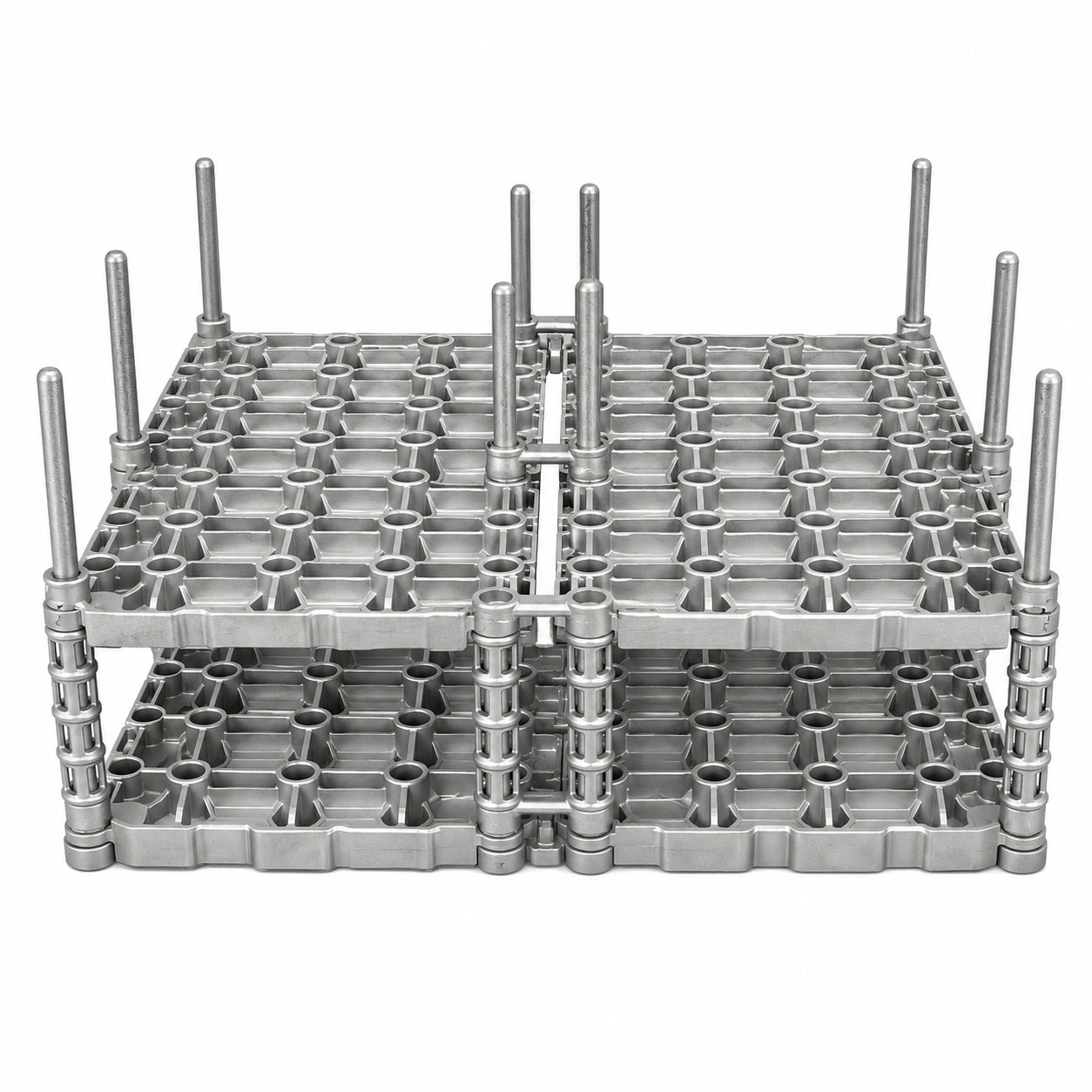
The photograph shows a two-level charging fixture with open-grid trays and vertical locating posts. It illustrates component geometry, not binder chemistry or a confirmed casting route.
Precision questions by part feature
| Part feature | What to review | Buyer evidence |
|---|---|---|
| Functional face | Is the surface machined, sealed or left as-cast? | Drawing finish note and datum scheme |
| Thin wall | Is filling and shell support adequate? | Section detail and process review |
| Internal passage | How will ceramic be removed and checked? | Passage drawing and access plan |
| Repeated holes | Are pattern and post-process dimensions defined? | Critical dimensions and inspection plan |
| Heavy junction | Is there a feeding or shrinkage concern? | Section map and casting review |
Surface quality and dimensional control
Silica-sol process discussions should distinguish a binder description from a finished-part result. The reviewed evidence set does not provide a numerical silica-sol tolerance or roughness value that can be published as a supplier capability. Use controlled drawings, inspection records and acceptance criteria for the part-level decision.
Silica sol versus water glass
Water glass and silica sol are separate shell-binder systems with different material descriptions and process considerations. A buyer choosing between them should compare geometry, required surface quality, quantity, cost assumptions, alloy and records. The water-glass shell route provides the companion comparison, while stainless investment castings organizes material and service-condition questions.
Applications and documentation
Possible application discussions include stainless brackets, fixtures, impellers, complex furnace hardware and other custom parts. The product family should follow the drawing and operating environment. For a product-focused route, see precision investment cast parts; it is a taxonomy and RFQ page, not a promise that every pictured part used silica sol.
Silica sol investment casting FAQ
What is silica sol in investment casting?
It is a water-based colloid containing very fine amorphous silica particles used in an investment-casting shell system. The actual binder specification and factory route must be confirmed for the project.
Is silica sol automatically more accurate?
Do not treat a general process reputation as a guaranteed result. Accuracy depends on pattern, shell, alloy, geometry, process controls, machining and the acceptance method for the specific part.
Does the image prove a silica-sol shell?
No. A photograph can show people or components, but it cannot identify the binder chemistry, alloy grade, certification or inspection result.
What should be marked on the drawing?
Mark datums, critical dimensions, functional surfaces, holes, passages, machining stock, surface requirements, inspection points and any areas where gates or supports are restricted.
RFQ checklist for silica sol casting
Send the controlled drawing and model, target alloy or service condition, quantity, critical features, surface and machining requirements, atmosphere, temperature, load, inspection criteria, material documents and packaging needs. Ask the quotation to state which binder, shell, finish and tolerance assumptions are confirmed rather than relying on generic process language.
Manufacturing and Product Evidence


For a project review, send your drawing, sample photos, furnace conditions, quantity and inspection requirements through our Contact Us page.


 +44 7419 144346