
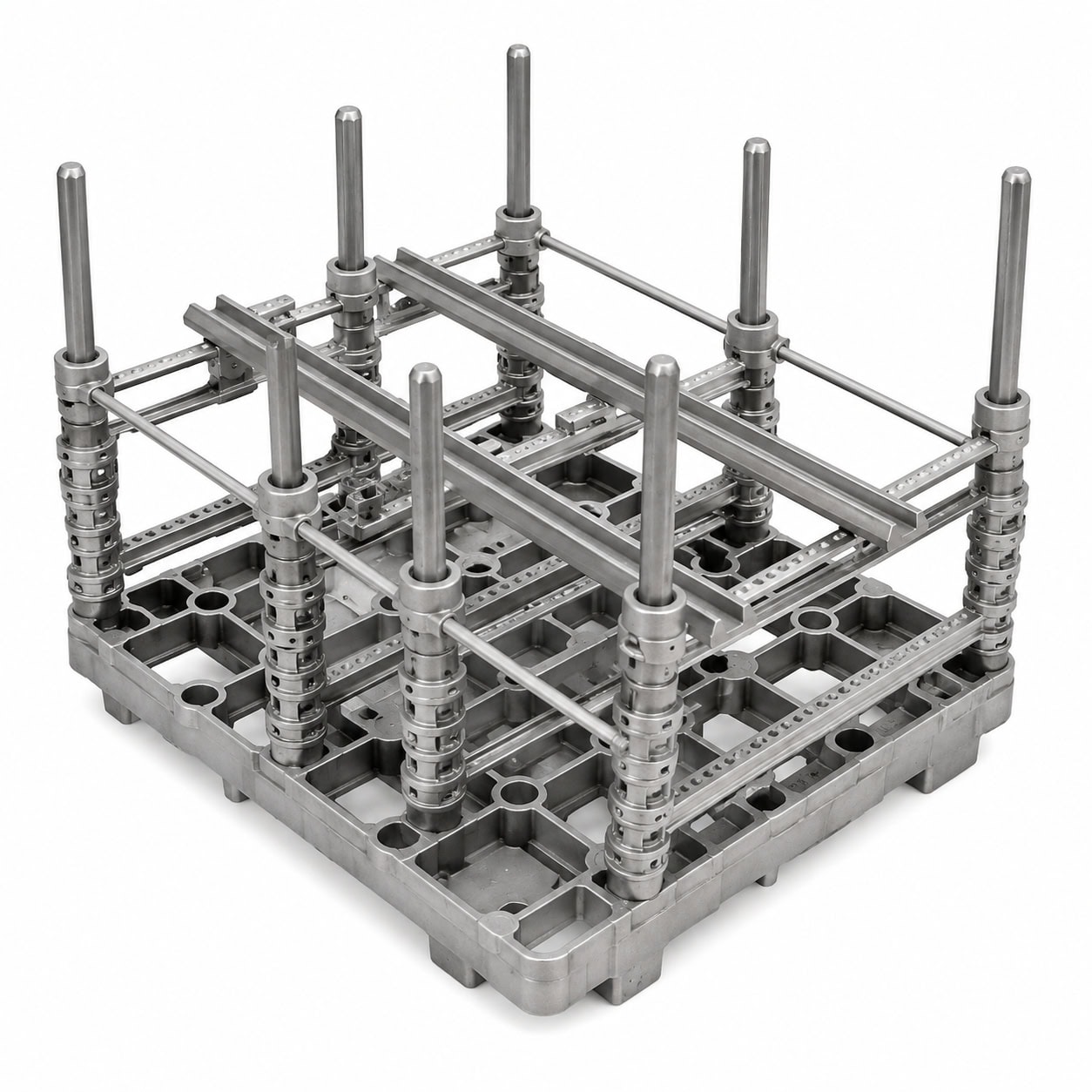
Direct answer: Heat treatment fixtures locate and support workpieces repeatedly inside a furnace. Selection depends on locating points, release movement, clearances, load, operating cycle and failure history. ECOOSUN can review a drawing or used sample for a project-specific cast fixture requirement.
Author: TOM Zhang, Chief Technology Officer
Technical review: ECOOSUN Engineering Department
Reliable heat treatment fixtures do more than hold a component in place. They control orientation, spacing, contact area and movement while the workpiece and fixture expand at different rates. A fixture that is stable for one cycle can bind, distort or mark the part after many repeated cycles.
Define the fixture reference system
Every fixture should have a clear datum, locating points and a defined loading direction. Record which surfaces are functional and which are only handling surfaces. This prevents a replacement fixture from copying wear marks that came from an incorrect loading method.
- Identify the primary locating surface and the allowable part movement.
- Separate locating functions from lifting and handling functions.
- Check clearance after both the fixture and part reach operating temperature.
- Design for cleaning, inspection and safe removal of scale.
Thermal expansion is part of the design
Metal parts, pins, rails and fixtures do not expand equally. A locating pin that is perfect at room temperature can lock the workpiece during heating. Use slots, floating supports or controlled clearances where movement is required. Do not add clearance blindly: excessive movement can allow the part to rub, fall or change orientation.
Load stability and atmosphere access
The fixture should support the part at repeatable points without creating a large heat sink. Contact points can produce local differences in heating or cooling and may leave marks on finished surfaces. Where atmosphere access matters, use open support geometry and avoid closed pockets that trap gas or oil.
Inspection after service
Inspection should focus on functional geometry, not appearance alone. Check locating pins, hooks, cross members, weld toes, casting transitions, wear pads and the fixture datum. Compare the fixture to the approved drawing and record permanent distortion after cooling.
| Inspection item | Question to answer |
|---|---|
| Location accuracy | Does the part sit on the approved datum? |
| Clearance | Will expansion cause binding in the furnace? |
| Contact marks | Are marks caused by design, scale or movement? |
| Crack or distortion | Is the damage local or repeated across the batch? |
When a custom fixture is the better option
A custom heat treatment fixture manufacturer should review the part drawing, furnace layout, cycle profile and loading method together. Replacement fixtures are often improved by changing contact points, adding replaceable wear components or separating the handling frame from the process support.
ECOOSUN supplies custom heat treatment fixtures and can coordinate them with heat treatment trays and baskets. Include the old fixture, failure photos and the parts it carries when requesting a quotation.
Reference basis: mould and fixture design, investment-casting practice, heat-resistant steel and defect-prevention references in the ECOOSUN technical library. Alloy and temperature data must be confirmed for each furnace cycle.
Three-stage fixture validation
Validate a fixture at three stages. First, check the drawing and the part datum before manufacturing. Second, perform a room-temperature fit check with the actual workpiece. Third, inspect the fixture and part after a representative thermal cycle. The third stage is essential because a fixture can pass a cold fit check and still bind or distort when it expands.
For repeat production, keep a simple fixture history: cycle count, repairs, dimensional checks, locations of contact marks and any change in the loading pattern. This history helps an engineer decide whether to repair, redesign or replace the fixture.
Design for maintenance
Replaceable wear pads, accessible pins and visible inspection marks can reduce downtime. A fixture should be easy to clean without damaging the functional datum. If scale hides a crack or a locating surface, the maintenance method is part of the fixture design.
Production context: The component reference should be read together with the manufacturing and inspection context behind the furnace application.

Request a project review: Send the drawing, used sample, key dimensions, furnace information and failure record through the ECOOSUN contact page.
c
FAQ
What should a buyer confirm for a heat treatment fixture requirement?
Confirm the drawing or used sample, key dimensions and interfaces, furnace type and clearance, load, operating cycle, failure evidence and inspection requirements. Final acceptance criteria should be agreed for the specific project.
Can ECOOSUN review a custom heat treatment fixture requirement?
Yes. ECOOSUN can review a customer drawing or used sample and discuss casting, laboratory and inspection requirements for a custom furnace-component project. Suitability and final scope are confirmed from the supplied information.
Related Heat Treatment Fixture Resources
Use these technical guides when specifying, inspecting or replacing heat treatment fixtures for an industrial furnace:
- Custom Heat Treatment Fixtures: Buyer RFQ and Drawing Checklist
- Heat Treatment Fixture Workpiece Location and Release Design
- Heat Treatment Fixture Dimensional Acceptance Checklist
- Why Does a Heat Treatment Fixture Lose Alignment?
Related ECOOSUN Products
Information for a Faster Quotation
Provide alloy grade or service conditions, workpiece geometry, locating and release points, dimensions and tolerances, cycle temperature, furnace type, quantity, drawing or used sample, and inspection requirements.
Request a Custom Quote · Send Your Drawing · WhatsApp ECOOSUN


 +44 7419 144346