
Silica sol investment casting is a lost-wax process that builds a ceramic shell with colloidal silica binder and selected refractory materials. It is often chosen for complex stainless and heat-resistant steel components when buyers need good surface reproduction, controlled dimensions, intricate grids and reduced finishing. Its higher process cost is justified only when those benefits add value to the part.
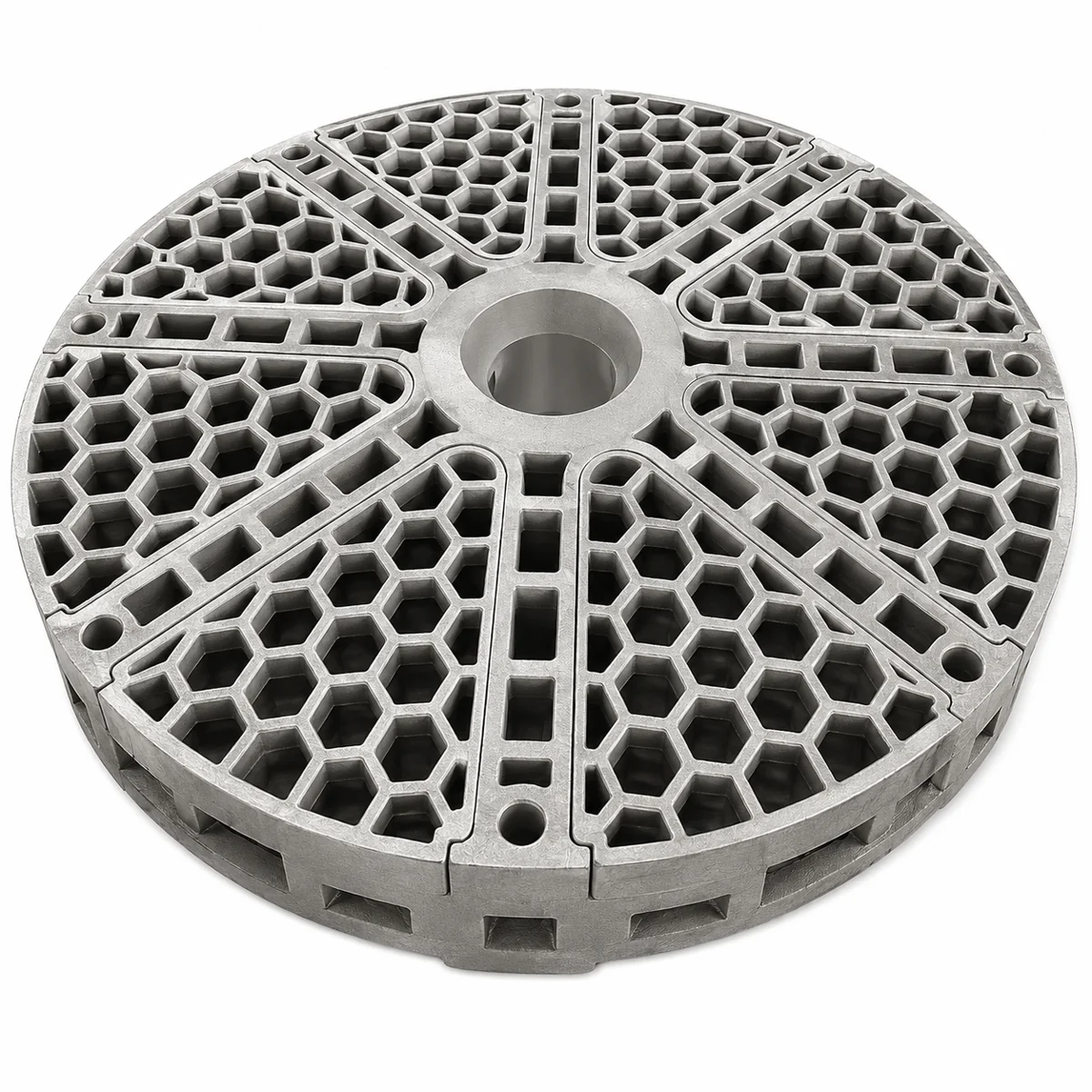
Representative complex furnace components suitable for a silica-sol process review. Final process selection depends on each drawing.
Where silica sol fits within lost-wax casting
Investment casting is the process family. Wax patterns are surrounded by a refractory shell, removed, and replaced by molten metal. Silica sol describes the binder system used to build that shell; it is not a different pattern principle.
This distinction matters in international purchasing. A quotation stating only “lost-wax casting” does not identify the shell system, face-coat material, wax route or achievable result. If silica sol is essential, the purchase specification should name it and still define the required casting outcome.
Water-glass investment casting is another market-recognized shell route, but ECOOSUN's present knowledge-page strategy does not promote it as a furnace-part service. Lost foam is separate: its foam pattern stays in dry sand and vaporizes during pouring.
How a silica-sol shell is built
The wax cluster is cleaned, dipped in refractory slurry, drained, stuccoed with refractory grain and dried. Fine face layers reproduce the wax surface; progressively stronger backup layers support the mould. The completed shell is dewaxed, fired and prepared for pouring.
What sounds simple is a coupled materials process. Colloidal stability, refractory selection, slurry condition, wetting, drainage, stucco coverage, room temperature, humidity, airflow and drying time all influence shell performance. Closely spaced grid openings can retain slurry or bridge if application and drainage are poorly controlled.
The shell must satisfy competing demands:
- reproduce fine geometry at the metal interface;
- resist handling and dewax stresses;
- retain adequate hot strength during pouring;
- manage gas and thermal behaviour;
- break away after solidification without damaging the casting.
Therefore, shell thickness or layer count should not be specified as an isolated universal number.
Why it is considered for heat-resistant steel parts
Heat-treatment fixtures often use high-alloy compositions and geometries that are expensive to machine. Silica-sol investment casting can be attractive for:
- repeated open cells and thin-to-moderate ribs;
- integrated bosses, feet, lugs and stacking features;
- parts requiring cleaner surface reproduction;
- near-net-shape components with selected machined datums;
- stable repeat orders where tooling and process qualification can be amortized;
- assemblies where reducing weld count improves consistency.
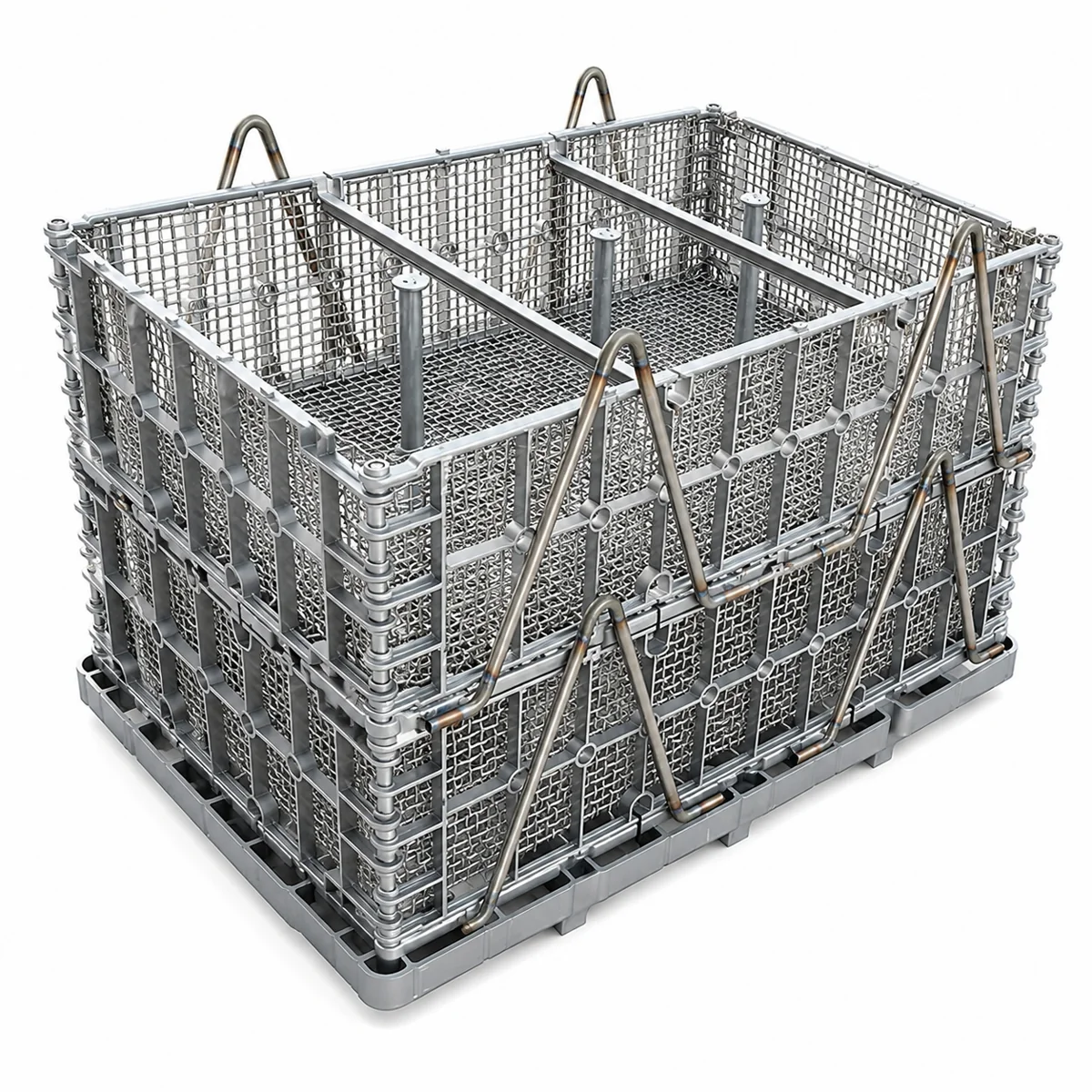
Heat-treatment basket with repeated openings and integrated structural features.
It is not automatically appropriate for every basket. Very large envelope, low quantity, massive simple sections or an emergency spare may favor another route. Long radiant-tube bodies commonly lead to centrifugal casting or fabrication, while silica-sol casting may still suit complex fittings or supports.
Realistic benefits and their conditions
| Potential benefit | Condition required to achieve it |
|---|---|
| Good surface reproduction | Stable wax, controlled face coat, clean melt and suitable finishing |
| Fine geometric detail | Tool accessibility, shell drainage and reliable metal filling |
| Reduced machining | Functional surfaces and achievable as-cast dimensions defined early |
| Repeatability | Controlled tooling, wax cycle, shell room and traceability |
| Complex part consolidation | Sound junction design, feeding and inspection access |
| Suitability for high-alloy castings | Qualified refractory, melting and pouring practice for the actual alloy |
The process cannot make a poor design immune to thermal fatigue or creep. A beautifully finished tray can still distort if its ribs do not match the load path or if the selected alloy lacks strength at the metal temperature.
Designing open-grid furnace castings
Balance ribs and nodes
Where several ribs meet, the local mass increases. Heavy nodes cool after surrounding ribs and can become shrinkage or stress locations. Use gradual transitions and avoid adding decorative mass that does not carry load.
Control cumulative dimensions
A single cell may be easy to reproduce, while a grid containing many cells accumulates shrinkage and straightness variation across the whole part. Overall envelope, assembly fit and functional datums deserve priority over cosmetic equality of every opening.
Provide drainage and shell access
Deep slots and narrow gaps must allow slurry to enter, drain and dry. The foundry should review pattern orientation and cluster spacing before tool release.
Design for service expansion
Locate the workpiece without over-constraining it. Show payload, supports and lifting points. A silica-sol shell improves manufacturing control; it does not replace high-temperature structural design.
Alloy terminology for cast furnace parts
Customers sometimes request wrought grades such as 310S or EN 1.4841 because these names are familiar in furnace construction. If the part is cast, the drawing must define an appropriate casting standard or an agreed chemical and performance specification. A wrought composition may be cast experimentally, but the name alone does not define foundry mechanical properties, weld repair, inspection or creep data.
For high-temperature load-bearing parts, evaluate cast heat-resistant grades containing appropriate chromium, nickel, carbon and carbide-forming additions. Selection depends on oxidation, carburization, sulphidation, thermal cycling and creep—not simply the highest temperature printed on a datasheet.
Process risks worth discussing with a supplier
Wax distortion
Long grids can move between injection and shell building. Ask how patterns are cooled, stored, supported and inspected.
Shell cracking or spalling
Rapid wax expansion, poor drying, weak joints or inappropriate thermal handling can damage the shell. Ask how dewax performance and shell condition are monitored.
Inclusions and surface defects
Loose refractory, shell reaction, slag or turbulent filling can create defects. Face-coat control and melt cleanliness both matter.
Misrun and cold shut
Thin or distant sections may not fill if the combined gating, shell temperature, alloy fluidity and pouring practice are inadequate.
Shrinkage and hot spots
Heavy rib intersections and hubs require feeding analysis. Raising pouring temperature alone is not a sound corrective strategy.
Distortion
Distortion can originate in wax, pouring, cooling, knockout, heat treatment, straightening or actual furnace service. Corrective action requires identifying the stage—not blaming the process name.
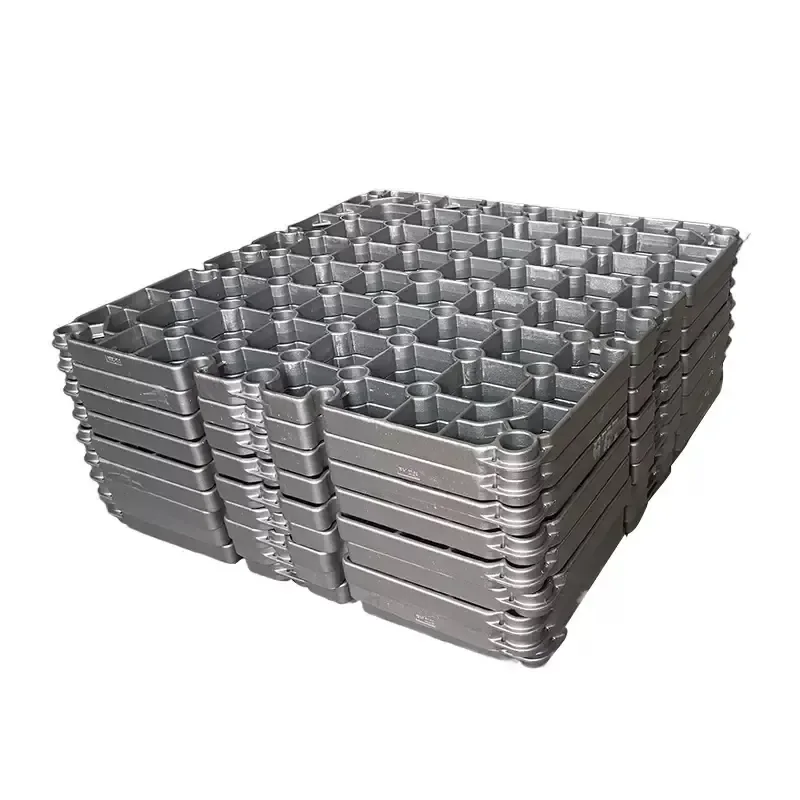
Stacked heat-treatment trays showing repeated open-grid geometry.
What makes silica-sol castings cost more
The cost comes from more than binder price. It can include controlled wax tooling, fine refractory face materials, repeated coating and drying cycles, environmental control, shell handling, alloy value, lower gross-to-net yield for difficult trees, finishing, heat treatment, straightening, machining and inspection.
The correct comparison is total delivered cost:
- tooling and first-article qualification;
- casting unit price at realistic batch quantity;
- machining and assembly saved;
- inspection and documentation;
- expected consistency over repeat orders;
- service value where geometry and alloy are improved.
A nominal process premium does not guarantee better quality. The supplier still needs a controlled line and a design within its capability.
Supplier qualification questions
- Which silica-sol shell route and refractory system are proposed for this alloy?
- How are wax dimensions, slurry condition and shell-room environment controlled?
- How are closely spaced grids prevented from bridging or remaining wet?
- What is the heat-analysis and traceability method?
- How will the runner and feeding design address heavy nodes?
- Which dimensions will be controlled as-cast and which will be machined?
- What first-article, NDT and repair approvals are proposed?
- How will the casting be supported during heat treatment?
Qualifying a silica-sol route for repeat orders
A first article should confirm more than appearance. Review the casting after all specified heat treatment and machining, because these operations can reveal distortion or subsurface conditions that were not evident at knockout. For an open furnace grid, check the overall envelope, support relationship and assembly fit in addition to selected individual cells.
The approved baseline should identify:
- drawing and tool revisions;
- alloy specification and heat identity;
- pattern/cluster arrangement;
- agreed critical dimensions and inspection zones;
- heat-treatment condition;
- permitted finishing and repair;
- representative photographs and reports.
Repeat orders should preserve that baseline or document controlled changes. A new refractory source, modified tree, tool repair or different heat-treatment fixture can affect results even when the part number remains unchanged.
When a hybrid construction may be better
Not every feature needs to be cast as one piece. A basket may combine cast corner nodes or frames with wrought mesh, rods or fabricated attachments. Hybrid construction can reduce casting envelope, simplify replacement and place different material forms where their properties are useful.
The trade-off is joint performance. Weld design, filler, heat input, inspection and differential expansion must suit the alloys and thermal cycle. The best solution is the one that balances casting integrity, assembly consistency, repairability and service life—not necessarily the one with the fewest part numbers.
Inspection plan for furnace components
A typical plan starts with chemistry, traceability, visual acceptance and critical dimensions. Add penetrant testing, radiography or other examinations where geometry, specification and failure consequence justify them. Open grids, dense hubs and pressure-containing parts should not receive identical inspection plans.
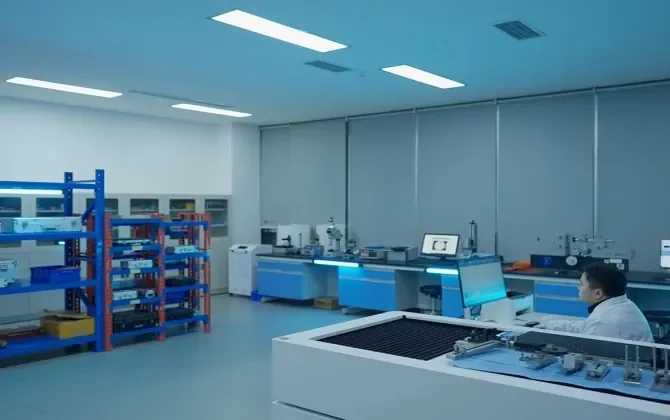
Quality-inspection area for heat-resistant cast components.
Define acceptance before production. Terms such as “no defects” or “export quality” are not measurable. State the applicable standard, zones, indication limits, sampling and required records.
RFQ information
Provide 2D and 3D data, cast-grade specification, quantity, critical datums, machining, surface and NDT requirements, furnace temperature, atmosphere, payload, support method, cycle and current failure history. Identify whether silica sol is mandatory or whether the foundry may recommend another process.
Frequently asked questions
Is silica sol investment casting the same as lost-wax casting?
It is a premium shell-system branch within the broader lost-wax investment-casting family.
Does silica sol always produce a better casting?
No. It offers useful capability, but tooling, wax, shell, melt, gating, heat treatment and inspection must all be controlled. The design must also suit the process.
Is it suitable for large heat-treatment baskets?
Possibly. Foundry envelope, wax handling, shell capacity, casting weight and cumulative grid distortion require project-specific review.
Can it cast 310S or 1.4841?
Those are commonly recognized wrought designations. For a casting, agree on the casting grade or complete chemical and performance specification rather than relying on the wrought name alone.
Why does the quotation take longer than a simple per-kilogram price?
The foundry must evaluate tooling, tree yield, shell handling, alloy, finishing, heat treatment, machining, inspection and delivery. Geometry and acceptance requirements can outweigh net weight.
Request a silica-sol casting review
ECOOSUN evaluates silica-sol investment casting for complex heat-resistant baskets, trays, fixtures and furnace replacement parts. Send drawings, material, quantity and furnace conditions through the contact page for a process review.
Related reading: Investment Casting, Investment Casting Process and Investment Casting Companies.
Technical note: Shell route, alloy equivalence, dimensional capability, temperature suitability and acceptance criteria require confirmation for the actual production line and service condition.
Engineering Information Needed Before Quotation
For a practical Silica Sol Investment Casting review, provide the 2D drawing or 3D model, material grade, part weight, order quantity, critical dimensions, surface requirements and any mandatory test records.
Silica Sol Investment Casting decisions are most reliable when these requirements are agreed before tooling, rather than corrected after the first trial batch.

 +44 7419 144346