
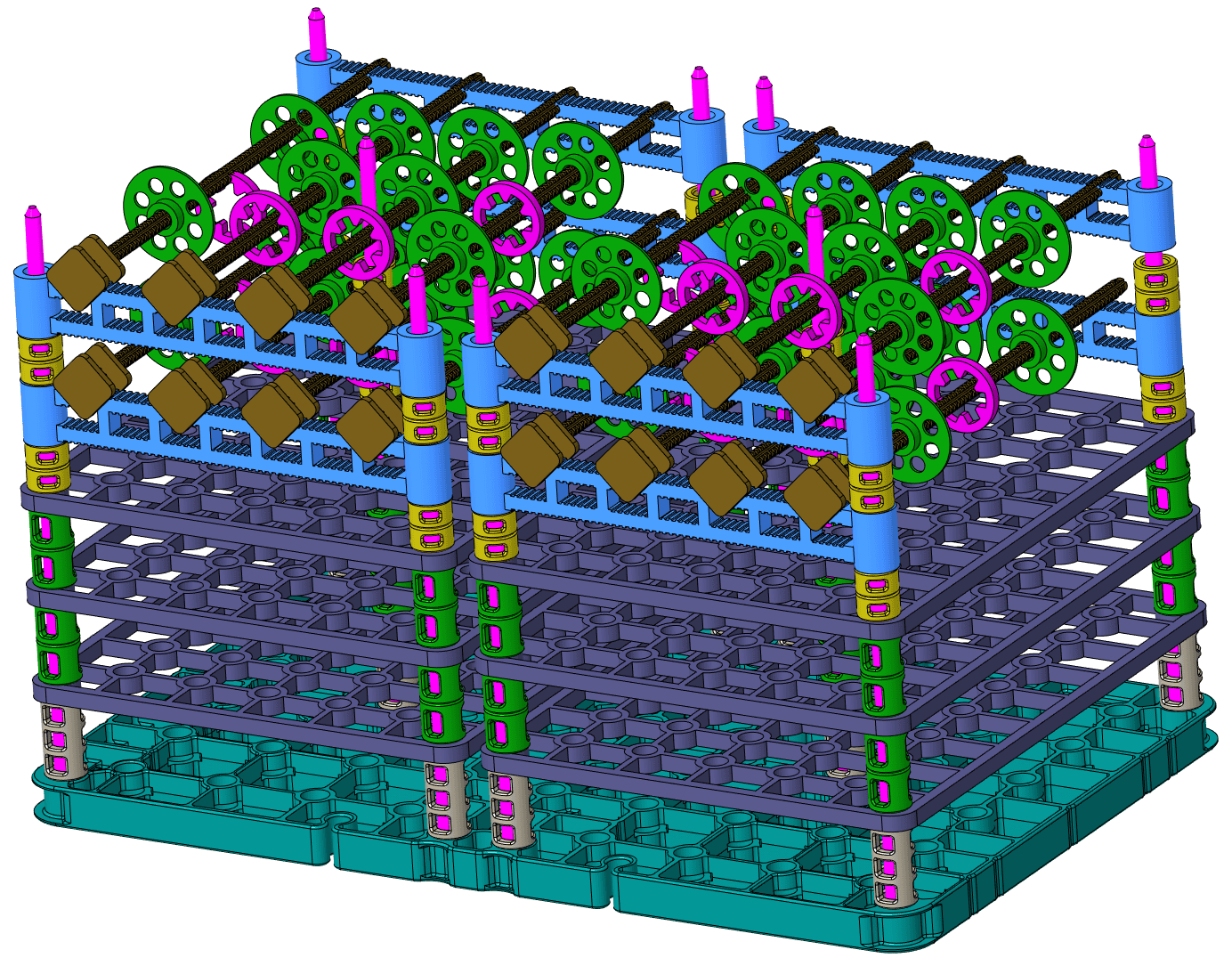
A complete heat treatment tray and fixture set should be specified with an assembly drawing and an itemized component list. The quotation should state what one set contains, how many sets are required and which loose spares are additional.
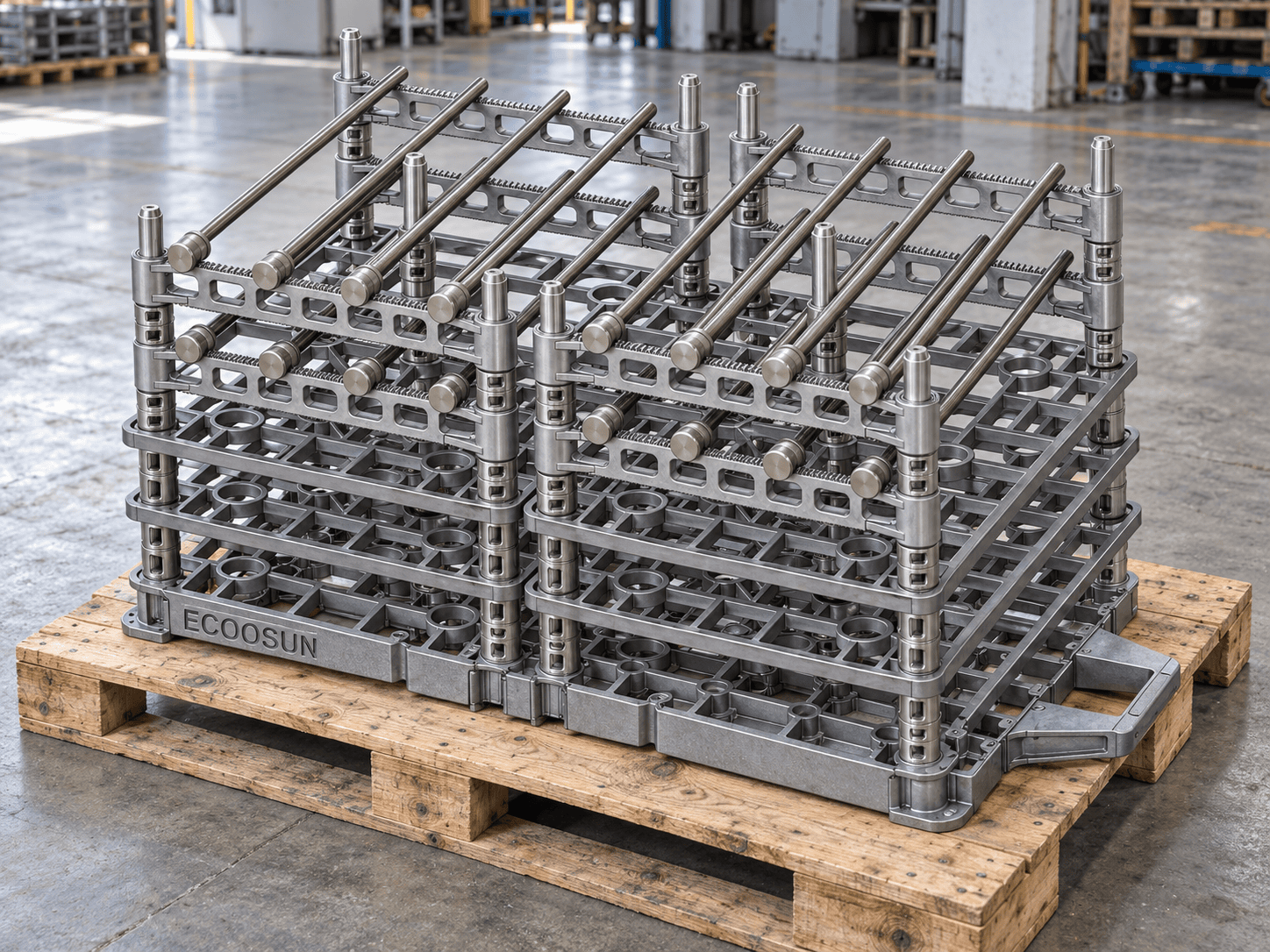
A photograph of an assembled stack is a useful discussion aid. It does not define every component, interface or quantity needed to build the purchased arrangement.
Start with the loading task
Describe the workpiece family, loading arrangement, handling method and furnace location. Provide the available space and identify the surfaces that support the complete set. If different workpieces use different arrangements, describe each configuration rather than combining them into one undefined “universal” set.
A material’s resistance to the furnace environment and its mechanical behavior at temperature are both relevant to heat-resistant components. The assembly review needs the loading and service conditions as well as a proposed alloy.[S2]
Define the contents of one set
| Component group | Information to enter in the bill of materials |
|---|---|
| Base tray | Drawing revision, quantity per set and support interfaces. |
| Grids or separators | Drawing, arrangement, quantity per level and number of levels. |
| Columns or support rods | Part number, location, applicable length or configuration and quantity. |
| Spacers and locating pieces | Part number, mating components and quantity per set. |
| Other hardware | Every applicable item, its supply responsibility and installation position. |
| Loose spares | Additional pieces listed separately from the components used in complete sets. |
Add an item-number balloon to each component on the assembly drawing. The component drawing, bill of materials and quotation should use the same identifier. If an item is supplied by the buyer or retained from an existing system, mark it explicitly.
Check the assembly interfaces before ordering
Pattern and tooling design considers locating references, component dimensions and acceptance requirements. For a purchased set, identify the finished interfaces that need to work together, rather than supplying only the overall stack dimensions.[S5]
Casting dimensional accuracy is affected by material, structure, process and tooling factors. The engineering review should establish the allowed limits for the relevant interfaces; it should not assume that matching nominal sizes automatically produce an acceptable assembly.[S6]
Ask for the intended stacking sequence and orientation to be shown. Confirm the assembled envelope and identify what will be checked as individual components versus as an assembled set. An image of a design model does not verify a load capacity.
Request a quotation that reconciles pieces and sets
Ask the supplier to list quantity per set, number of complete sets, total supplied pieces and loose-spare quantities. Review the arithmetic against the assembly list. Keep optional levels or alternate spacer lengths in separate configurations so they are not counted twice.
Agree component identification, packaging groups and the required documents. A receiving team should be able to connect each package to the bill of materials without rebuilding the quotation from photographs.
Send ECOOSUN your furnace-space information, workpiece layout and draft assembly list. Identify the components to be newly supplied, retained or purchased as loose spares so we can review a defined set.
Related product information: Heat Treatment Trays · Heat Treatment Fixtures · Send drawings and requirements to ECOOSUN.
Technical references and scope
The references support the marked technical principles. The purchasing checklists and workflow are editorial applications. Historical references do not establish current standard editions, project-specific acceptance limits or ECOOSUN performance guarantees.
- S2. Foundry Handbook, Volume 2: Cast Steel (Chinese-language reference; title translated); PDF pages 188, 189, printed pages 171, 172. Heat resistance includes environmental/oxidation resistance and high-temperature mechanical behavior, including time-dependent behavior.
- S5. Foundry Tooling Design Handbook (Chinese-language reference; title translated); PDF pages 9, printed pages 7. Tooling selection considers production and technical requirements; pattern dimensions include process allowances and contraction.
- S6. Foundry Process Design (Chinese-language reference; title translated); PDF pages 19, printed pages 12. Casting dimensional tolerance and factors affecting dimensional accuracy.
Related Heat Treatment Tray Resources
Use these technical guides when specifying, inspecting or replacing heat treatment trays for an industrial furnace:
- Heat Treatment Trays: Rib Design, Perforation and Distortion Control
- Heat Treatment Tray Design: Load, Alloy and Deformation
- Heat Treatment Tray Installation and Furnace Clearance Guide
- Heat Treatment Tray Acceptance Inspection Checklist
- Heat Treatment Baskets vs Trays vs Fixtures
Related ECOOSUN Products
Manufacturing and quality evidence · Official company facts and current catalog
Information for a Faster Quotation
Provide alloy grade or service conditions, tray dimensions, load capacity, flatness or clearance requirements, operating temperature, furnace type, quantity, drawing or used sample, and inspection requirements.
Request a Custom Quote · Send Your Drawing · WhatsApp ECOOSUN

 +44 7419 144346