
Direct answer: Radiant tubes transfer heat into a heat-treatment furnace through a burner or heating system. Selection depends on the furnace layout, burner interface, dimensions, atmosphere, operating cycle and failure history. ECOOSUN can review a drawing or used sample for a project-specific replacement.
Radiant tubes look simple from outside: a heated tube, a burner or heating element, and a connection to the furnace shell. In service, however, the tube becomes the boundary between combustion energy and the working atmosphere. Its geometry affects heat distribution, burner alignment, maintenance access and the cost of an eventual replacement.
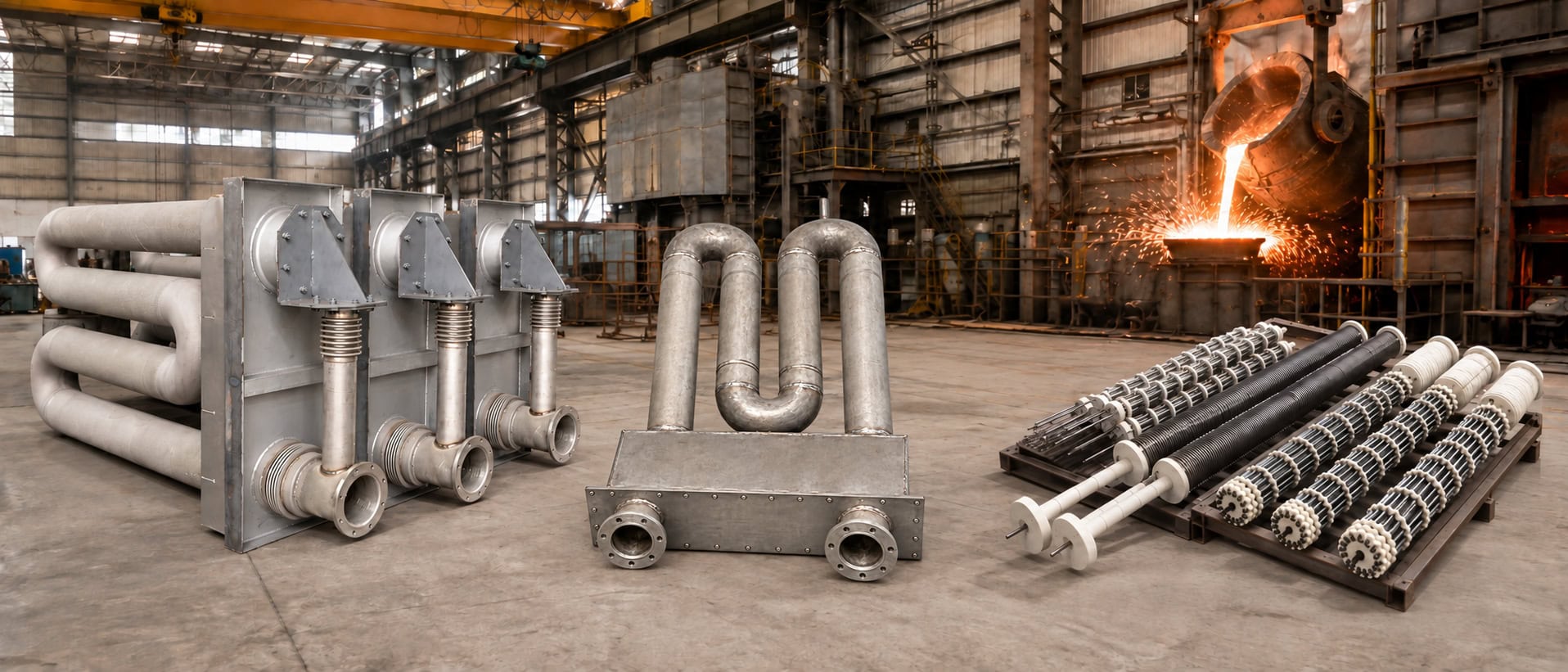
This guide is for heat-treatment plants and furnace builders comparing furnace radiant tubes for a new line or a replacement project. It focuses on practical selection questions rather than a one-size-fits-all catalogue.
Start with the heat path, not the tube name
A straight tube, U-type tube and W-type tube all transfer heat by radiation, but they do not occupy the same space or create the same service conditions. Before choosing a shape, record the heated length, available envelope, burner position, support points, working temperature range, atmosphere and the way the load moves through the furnace. A tube that fits the drawing can still be wrong if the flame path, expansion direction or inspection access is ignored.
Geometry comparison
| Configuration | Where it is often useful | Questions to verify |
|---|---|---|
| Straight tube | Long, direct heating zones with simple access | Can the furnace provide enough length and support? Where will thermal expansion go? |
| U-type tube | Compact furnace layouts where the hot zone must turn back | Is the bend radius compatible with casting or fabrication limits and cleaning access? |
| W-type tube | Installations needing a longer effective heating path in a limited envelope | Will the multiple bends maintain even temperature and allow safe removal? |
The table is a starting point, not a substitute for a drawing review. In a replacement project, measure the complete assembly, including flange, burner seat, centerline, support brackets and the distance from the furnace wall to the hot section.
Four design checks that protect service life
1. Uniform wall and transition geometry
Heat-treatment and casting references place strong emphasis on avoiding abrupt section changes. A sudden change in wall thickness or a sharp internal transition can concentrate thermal stress. Ask the supplier how the pattern, core and finishing process control those transitions, especially around bends and burner-end features.
2. Expansion and support
The hot length needs room to expand. Fixed supports at both ends can turn normal expansion into bending or cracking. The furnace drawing should identify the fixed point, sliding point and clearance around the tube. If those details are unknown, send photographs and measurements before asking for a quote.
3. Atmosphere and surface condition
Oxidizing, carburizing, nitriding and vacuum-related conditions do not expose the tube to the same risks. Surface scale, carburization, deposits and thermal cycling can change the effective wall condition. Describe the actual atmosphere and the cleaning practice, rather than only stating “high temperature.”
4. Burner alignment
For gas-heated designs, a misaligned burner can create a local hot spot. Check the burner throat, flame length, combustion air arrangement and the inspection method. ECOOSUN can review the burner-end dimensions with the furnace builder before casting or machining starts.
What to send for a replacement quote
- Overall length, hot length and outside diameter.
- Section drawing showing bends, flanges, bosses and centerlines.
- Furnace type, heating zone, atmosphere and operating cycle.
- Photos of the failed tube and the surrounding burner or support.
- Required quantity, delivery window and any inspection documents.
If the original drawing is unavailable, a measured sketch is still useful. Add the direction of installation and mark the area that failed first. This helps distinguish a tube problem from a support, burner or furnace-control problem.
Why buyers compare more than the alloy name
Material selection matters, but it is only one part of a radiant-tube decision. Casting soundness, dimensional stability, finishing, machining at connection points and traceability all influence whether the tube can be installed without rework. A credible supplier should explain which features are controlled during pattern making, casting, heat treatment, machining and final inspection.
For related furnace components, see ECOOSUN radiant tubes, heat treatment furnace parts and custom heat-resistant alloy parts. For a drawing-based review, send the operating details to ECOOSUN.
Short buyer checklist
Choose the geometry that matches the furnace envelope, keep the expansion path clear, verify the burner alignment, describe the atmosphere, and request dimensional and material traceability. Those five checks usually produce a better result than selecting by tube shape alone.
Production context: The component reference should be read together with the manufacturing and inspection context behind the furnace application.

FAQ
What should a buyer confirm for a radiant tube requirement?
Confirm the drawing or used sample, key dimensions and interfaces, furnace type and clearance, load, operating cycle, failure evidence and inspection requirements. Final acceptance criteria should be agreed for the specific project.
Can ECOOSUN review a custom radiant tube requirement?
Yes. ECOOSUN can review a customer drawing or used sample and discuss casting, laboratory and inspection requirements for a custom furnace-component project. Suitability and final scope are confirmed from the supplied information.
Related Radiant Tube Resources
Use these technical guides when specifying, inspecting or replacing radiant tubes for an industrial furnace:
- Radiant Tubes for Annealing and Heat-Treatment Furnaces
- Straight, U-Type or W-Type Radiant Tubes
- Radiant Tube Failure: Cracking, Sagging and Oxidation
- Radiant Tube Installation and Connection Inspection Guide
- Industrial Furnace Radiant Tubes: Material and Service Life
Related ECOOSUN Products
Information for a Faster Quotation
Provide alloy grade or service conditions, straight/U/W form, tube dimensions, burner and connection details, operating temperature, furnace zone, quantity, drawing or used sample, and inspection requirements.
Request a Custom Quote · Send Your Drawing · WhatsApp ECOOSUN


 +44 7419 144346