
Direct answer: Radiant tubes transfer heat into a heat-treatment furnace through a burner or heating system. Selection depends on the furnace layout, burner interface, dimensions, atmosphere, operating cycle and failure history. ECOOSUN can review a drawing or used sample for a project-specific replacement.
When a furnace line is stable, radiant tubes are easy to ignore. When temperature uniformity drifts, the tube becomes one of the first components to investigate. The useful question is not only whether the tube is the correct shape; it is whether the complete tube installation is delivering a repeatable heat pattern without forcing the casting to absorb installation errors.
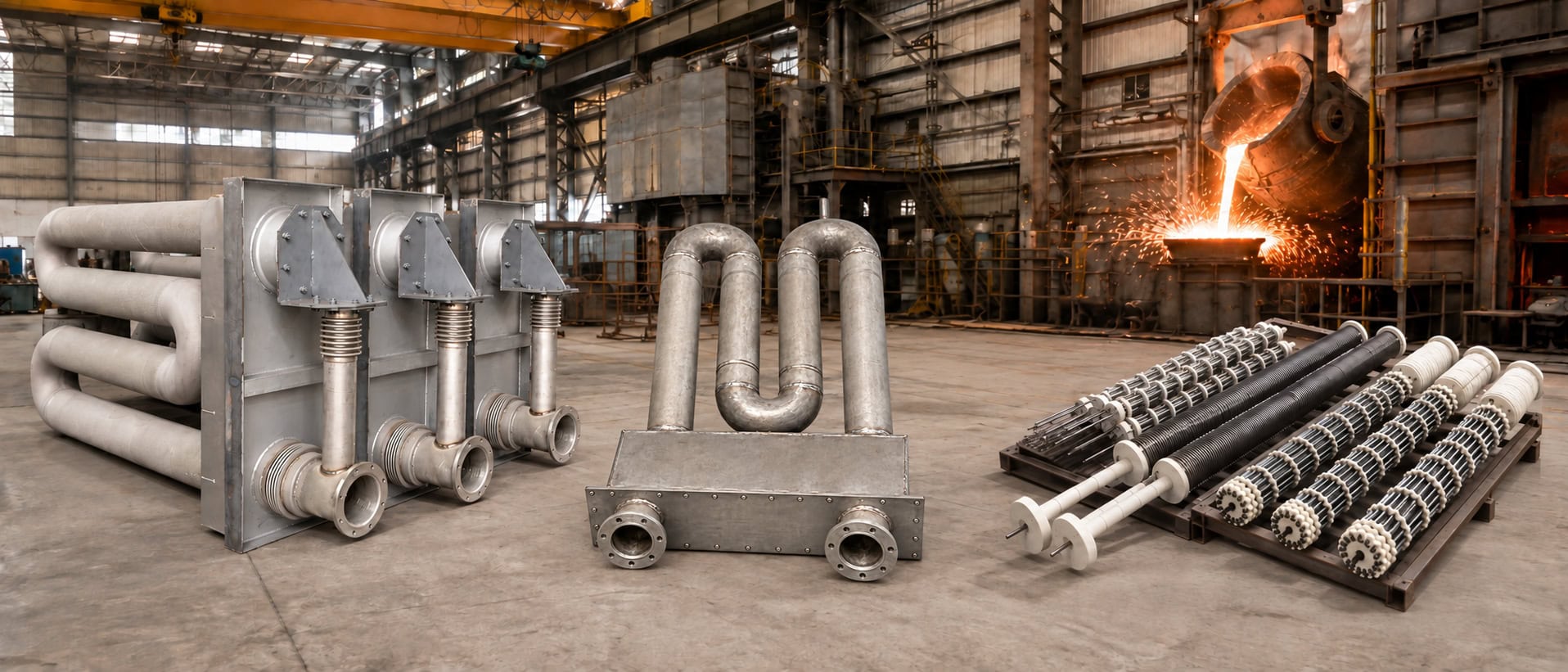
This field guide gives maintenance and commissioning teams a practical way to review furnace radiant tubes after installation, during a planned inspection or when a zone begins to show uneven heating.
Before the first heat
Compare the delivered tube with the approved drawing. Check the hot length, connection face, burner seat, centerline, support locations and the clearance to refractory. Do not pull a tube into alignment with bolts or clamps. If a flange needs force to meet the furnace shell, stop and resolve the mismatch before firing.
What to record during commissioning
| Observation | What it may indicate | Useful record |
|---|---|---|
| Temperature rises quickly at one location | Flame impingement, burner alignment or local clearance issue | Zone map, burner setting, photograph |
| Tube touches refractory after heating | Insufficient expansion clearance or support restriction | Cold and hot position measurements |
| Uneven colour or scale band | Local temperature difference, atmosphere effect or deposit | Band location, cycle, atmosphere |
| Connection leaks or moves | Gasket, flange, support or thermal-growth problem | Torque record and inspection note |
These records are more useful than a general statement that the tube “ran hot.” They show whether the issue follows the burner, the furnace zone or the physical support.
Alignment checks that take minutes
- Confirm the burner axis is concentric with the tube entry.
- Check that the tube is not carrying the weight of the burner assembly.
- Verify the intended fixed and sliding support points.
- Measure clearance around bends and the hot end.
- Inspect the sealing face for damage or uneven contact.
A small misalignment can become more serious after repeated cycles because the tube expands, contracts and carries the thermal gradient created by the burner. If the same location shows marks after every cycle, include that evidence when ordering a replacement.
When a new tube does not solve the old problem
Repeated damage is often a system clue. Review fuel and air settings, burner condition, refractory clearance, support movement, furnace control changes and the cleaning method. A replacement tube should be checked against those conditions rather than installed as an isolated spare.
ECOOSUN reviews drawing-based enquiries for radiant tubes and other heat treatment furnace parts. Include cold measurements, hot observations and photos when asking for a technical review.
Inspection note for the maintenance file
Keep the approved drawing revision, tube identification, burner details, installation measurements and first-cycle observations together. This record makes the next replacement faster and gives the furnace OEM a clear basis for improving the design.
Summary
Good radiant-tube performance starts before the first firing. Check the interface, leave an intentional expansion path, record the heat pattern and treat repeated local damage as a system issue. These habits protect the tube and the production schedule at the same time.
Production context: The component reference should be read together with the manufacturing and inspection context behind the furnace application.

Request a project review: Send the drawing, used sample, key dimensions, furnace information and failure record through the ECOOSUN contact page.
FAQ
What should a buyer confirm for a radiant tube requirement?
Confirm the drawing or used sample, key dimensions and interfaces, furnace type and clearance, load, operating cycle, failure evidence and inspection requirements. Final acceptance criteria should be agreed for the specific project.
Can ECOOSUN review a custom radiant tube requirement?
Yes. ECOOSUN can review a customer drawing or used sample and discuss casting, laboratory and inspection requirements for a custom furnace-component project. Suitability and final scope are confirmed from the supplied information.
Related Radiant Tube Resources
Use these technical guides when specifying, inspecting or replacing radiant tubes for an industrial furnace:
- Radiant Tubes for Annealing and Heat-Treatment Furnaces
- Straight, U-Type or W-Type Radiant Tubes
- Radiant Tube Failure: Cracking, Sagging and Oxidation
- Radiant Tube Installation and Connection Inspection Guide
- Industrial Furnace Radiant Tubes: Material and Service Life
Related ECOOSUN Products
Information for a Faster Quotation
Provide alloy grade or service conditions, straight/U/W form, tube dimensions, burner and connection details, operating temperature, furnace zone, quantity, drawing or used sample, and inspection requirements.
Request a Custom Quote · Send Your Drawing · WhatsApp ECOOSUN


 +44 7419 144346