
Direct answer: Radiant tubes transfer heat into a heat-treatment furnace through a burner or heating system. Selection depends on the furnace layout, burner interface, dimensions, atmosphere, operating cycle and failure history. ECOOSUN can review a drawing or used sample for a project-specific replacement.
A failed radiant tube is not always a material problem. Cracking, sagging and oxidation can be linked to temperature distribution, burner adjustment, support conditions, atmosphere, wall thickness, installation stress or an alloy that does not match the process.
Failure symptoms and useful clues
Cracking near a bend or connection may point to thermal stress, installation restraint, local overheating or a stress concentration. Photograph the full tube, not only the crack, and mark its position relative to the burner and supports.
Sagging or distortion can be related to unsupported length, uneven heating, tube geometry, long exposure or loading/contact with another component. Record whether the deformation is uniform or concentrated in one zone.
Heavy oxidation or surface scaling should be assessed together with the furnace atmosphere, temperature history, combustion condition and maintenance records. Surface appearance alone is not enough to select a replacement alloy.
A practical replacement investigation
Before requesting a quote, collect:
- the original tube drawing or measured dimensions;
- tube type: straight, U-type, W-type or another configuration;
- burner and exhaust connection details;
- working temperature and atmosphere;
- installation date and approximate service cycles;
- photos of cracks, scale, holes, sagging and support areas;
- any previous inspection or maintenance report.
ECOOSUN can review these inputs when preparing custom Radiant Tubes. Potential alloy options include EN 1.4852 / 25Cr-35Ni-Nb, EN 1.4851 / X15CrNiSi25-21, EN 1.4845 / 25Cr-20Ni, EN 1.4857 / HP40 and HU / ZG45Ni38Cr18Si2. Final selection must follow the actual furnace conditions and design.
ECOOSUN has more than 20 years of casting experience and supports heat-treatment plants and industrial furnace manufacturers. Request a preliminary review through Contact Us or WhatsApp.
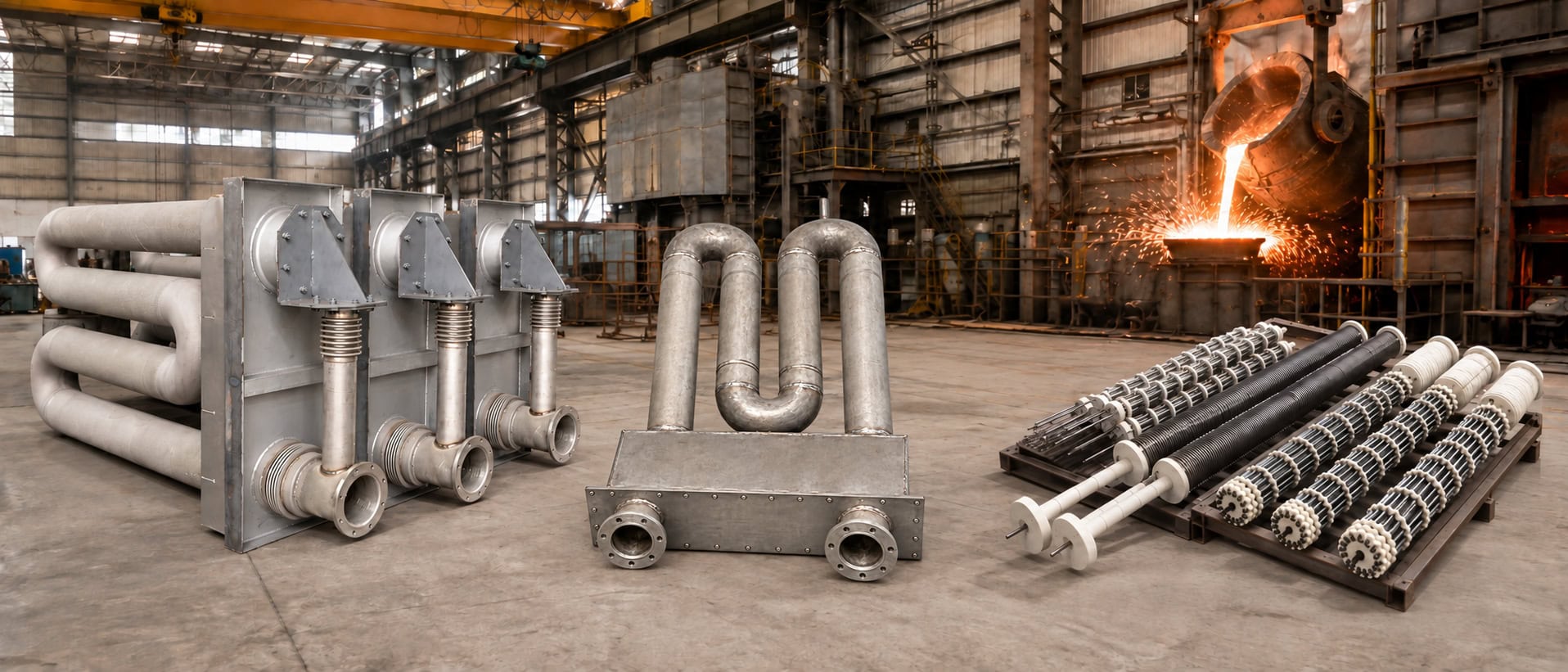
Production context: The component reference should be read together with the manufacturing and inspection context behind the furnace application.

FAQ
What should a buyer confirm for a radiant tube requirement?
Confirm the drawing or used sample, key dimensions and interfaces, furnace type and clearance, load, operating cycle, failure evidence and inspection requirements. Final acceptance criteria should be agreed for the specific project.
Can ECOOSUN review a custom radiant tube requirement?
Yes. ECOOSUN can review a customer drawing or used sample and discuss casting, laboratory and inspection requirements for a custom furnace-component project. Suitability and final scope are confirmed from the supplied information.
Related Radiant Tube Resources
Use these technical guides when specifying, inspecting or replacing radiant tubes for an industrial furnace:
- Radiant Tubes for Annealing and Heat-Treatment Furnaces
- Straight, U-Type or W-Type Radiant Tubes
- Radiant Tube Installation and Connection Inspection Guide
- Industrial Furnace Radiant Tubes: Material and Service Life
Related ECOOSUN Products
Information for a Faster Quotation
Provide alloy grade or service conditions, straight/U/W form, tube dimensions, burner and connection details, operating temperature, furnace zone, quantity, drawing or used sample, and inspection requirements.
Request a Custom Quote · Send Your Drawing · WhatsApp ECOOSUN

 +44 7419 144346