
Direct answer
For a radiant tube replacement RFQ, provide the tube drawing or worn tube, overall and critical dimensions, end and burner connection details, support arrangement, furnace interface, atmosphere, temperature range, thermal-cycle information and failure evidence. Photographs should show the installed orientation, heated section, connections and damage. The supplier should confirm the application and inspection requirements before a replacement route and quotation are finalized.
Buyer decision point
| Input to confirm | Why it matters |
|---|---|
| Drawing or used sample | Defines the geometry and replacement reference. |
| Furnace interface and clearance | Confirms fit, handling and movement inside the furnace. |
| Load and operating cycle | Supports review of loading, thermal expansion and service conditions. |
| Failure record and inspection requirement | Connects the replacement scope to the observed problem and acceptance check. |
Geometry and connection details
Record the tube’s overall length, outside dimensions, wall or section details where confirmed, bends, flanges, supports, end geometry and burner connection. Mark which dimensions control installation and which are non-critical. Include the drawing revision if available.
Photograph both ends and any connection or mounting feature. A tube that looks similar externally may still have different interfaces, clearances or support requirements.
Furnace and operating information
Identify the furnace type, installation location, support points, burner arrangement, atmosphere and thermal-cycle pattern. Note whether the tube is heated continuously or through repeated start-up and shutdown cycles. Record nearby components and any evidence of contact, movement or interference.
Provide the confirmed temperature range used by the buyer. Do not turn an incomplete operating record into a general maximum-temperature or service-life claim.
Failure evidence
Record the failure mode using observable terms such as cracking, distortion, thinning, oxidation, leakage, local damage or connection failure. Mark the location and orientation. Photograph the tube before cutting or cleaning it, and include a scale reference.
If the failure happened after a maintenance, burner, atmosphere, support or process change, record that timing. The change may be important to the engineering review.
Inspection and quotation package
Send the drawing or sample, dimensional records, installation photographs, furnace information, failure history, required machining or fit-up and inspection expectations. State whether the request is for one replacement, a repeat supply or a new-furnace application.
ECOOSUN supplies custom furnace radiant tubes for heat-treatment furnace replacement and new-equipment applications. ECOOSUN can review the casting route and inspection scope for the specified application. Visit Radiant Tubes or contact ECOOSUN.
Frequently asked questions
Can a radiant tube be quoted from a photograph?
A photograph can begin the discussion, but dimensions, connection details, furnace information and failure evidence are normally needed for a reliable quotation.
Should the failed tube be discarded?
Keep it until the required photographs, measurements and review are complete. The physical sample may show damage not visible in a photograph.
Does a replacement tube automatically use the same design?
Not always. If the failure or equipment has changed, the geometry, supports, connections and operating information should be reviewed before copying the part.
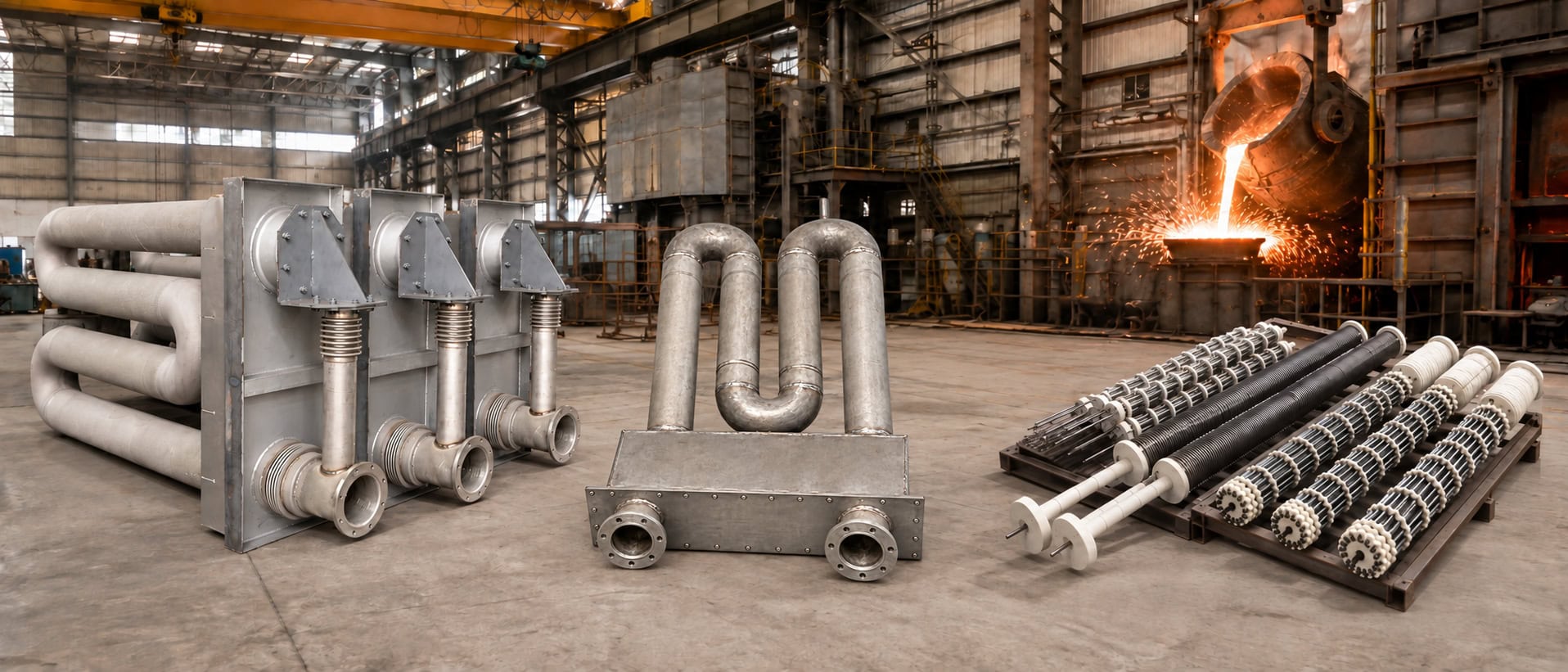
Production context: The component reference should be read together with the manufacturing and inspection context behind the furnace application.

RFQ information checklist
For a useful first review, send the drawing or used sample, key dimensions, furnace type, load, operating cycle, visible failure evidence and any required inspection points. Final material and acceptance decisions are confirmed for the specific project.
Related Radiant Tube Resources
Use these technical guides when specifying, inspecting or replacing radiant tubes for an industrial furnace:
- Radiant Tubes for Annealing and Heat-Treatment Furnaces
- Straight, U-Type or W-Type Radiant Tubes
- Radiant Tube Failure: Cracking, Sagging and Oxidation
- Radiant Tube Installation and Connection Inspection Guide
- Industrial Furnace Radiant Tubes: Material and Service Life
Related ECOOSUN Products
Information for a Faster Quotation
Provide alloy grade or service conditions, straight/U/W form, tube dimensions, burner and connection details, operating temperature, furnace zone, quantity, drawing or used sample, and inspection requirements.
Request a Custom Quote · Send Your Drawing · WhatsApp ECOOSUN

 +44 7419 144346