
Short answer: Radiant tube length, outside diameter, wall thickness and operating temperature must be selected together with the furnace zone, burner or heating connection, support span, atmosphere and required heat output.
Why one dimension cannot be specified alone
A radiant tube is a working furnace component, not simply a length of pipe. Its heated length, overall length, outside diameter, wall thickness and connection geometry determine heat transfer, stiffness, gas flow, installation clearance and replacement compatibility. A buyer who sends only an outside diameter may receive a part that cannot fit the burner, support, flange or furnace zone.
For quotation, separate the overall length from the effective heated length. Mark the cold ends, burner connection, flange, mounting plate, support points and any internal baffle or return path on the drawing. Include the orientation and the distance between the tube centerline and the work zone.
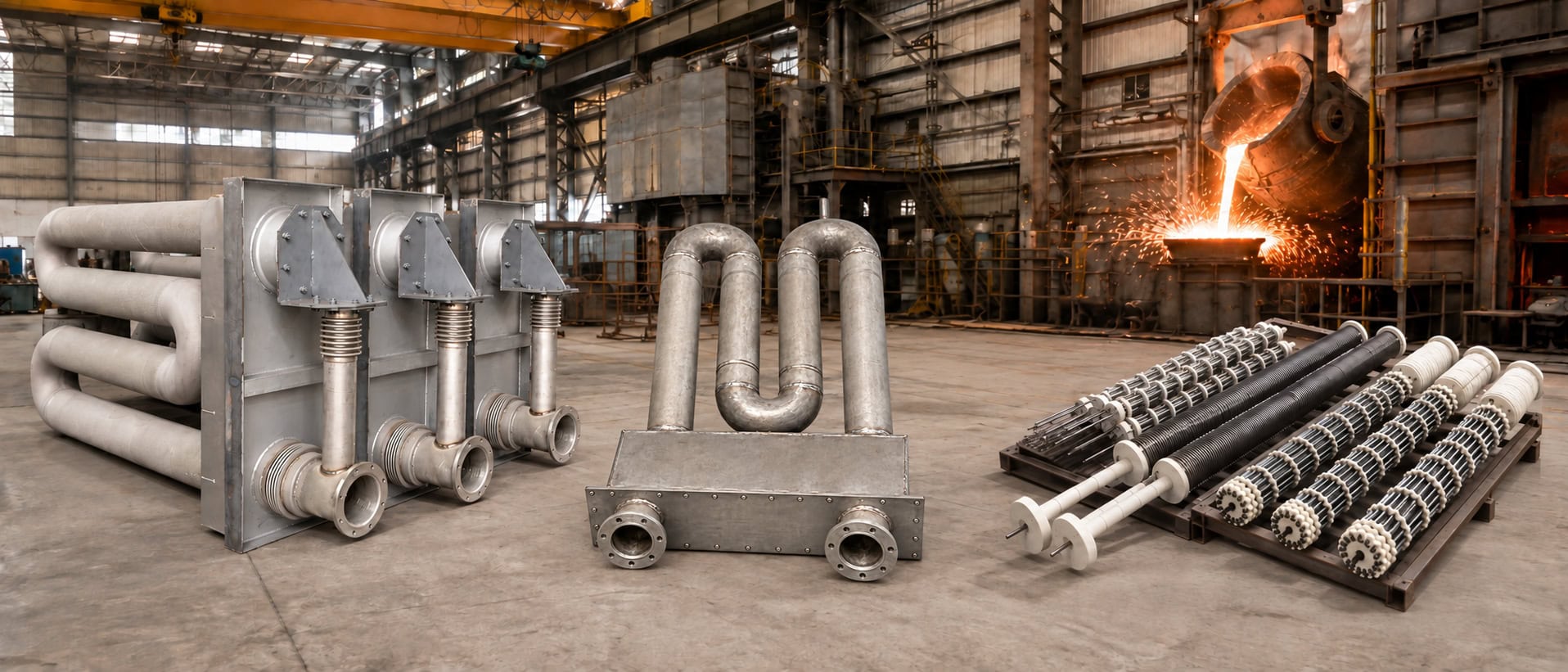
Straight, U-type and W-type supply configurations
Straight radiant tubes are often used where the furnace layout allows a direct heated span and accessible burner connection. U-type radiant tubes provide a return path in a compact arrangement and require careful control of bend geometry, center distance and support alignment. W-type or multi-leg tubes can provide a longer heated path in a limited furnace width, but their leg spacing, bend radii and differential expansion need to be checked in the complete assembly.
When replacing a bent tube, provide a dimensional drawing or a full-size sample if possible. The supplier should confirm centerline dimensions, leg spacing, flange orientation and installation clearance rather than relying on a generic U or W description.
Length, diameter and wall thickness
- Length: define overall length, effective heated length, cold-end length and the support-to-support span.
- Diameter: provide outside diameter and, where relevant, inside diameter, burner clearance and gas-flow requirement.
- Wall thickness: specify nominal thickness, minimum acceptable thickness and any machining or corrosion allowance.
- Connections: include flange, threaded or welded connection details, bolt pattern, sealing face and axis location.
- Geometry: include straightness, bend radius, center distance, end angle and allowable installation deviation.
Final dimensions and tolerances should be taken from the furnace drawing and the existing replacement part. A nominal reference range without the furnace interface can create an expensive fit-up problem.
Operating temperature and alloy selection
Temperature selection should consider tube-metal temperature, furnace atmosphere, burner flame exposure, cycle duration and the expected number of starts and stops. Flame impingement, carburization, oxidation and thermal shock can shorten life even when the set temperature appears acceptable.
For preliminary discussion, reference heat-resistant grades include EN 1.4852 / 25Cr-35Ni-Nb at approximately 1100–1150°C, EN 1.4851 / X15CrNiSi25-21 at approximately 900–1000°C, EN 1.4845 / 25Cr-20Ni at approximately 900–1000°C, EN 1.4857 / 25Cr-35Ni / HP40 at approximately 1050–1150°C, and HU / ZG45Ni38Cr18Si2 around 1093°C. These values are approximate service references only. Final material selection must be confirmed against the actual atmosphere, tube temperature and failure history.
Inspection points for a replacement radiant tube
A purchasing specification can include overall and effective length, outside and inside diameter, wall thickness, straightness or bend geometry, flange dimensions, surface condition and end finish. Chemical composition, hardness, dimensional inspection and suitable non-destructive testing can be requested according to the quality plan. For cast tubes, buyers may also ask for traceability to the heat or batch and inspection records for critical sections.
Radiant tube RFQ checklist
- Furnace manufacturer, furnace type, zone location and installation orientation.
- Tube drawing, sample, photographs and connection details.
- Overall length, heated length, OD, ID, wall thickness and support span.
- Straight, U-type, W-type or other geometry with centerline dimensions.
- Operating temperature, atmosphere, fuel, cycle and heating/cooling rate.
- Quantity, required delivery date, previous failure mode and inspection documents.
ECOOSUN supplies custom radiant tubes and can review related furnace rolls or furnace internals when a furnace outage requires coordinated replacement parts. Send the drawing through Contact Us, request a Request a Custom Quote, or use Send Your Drawing. For a quick technical discussion, contact ECOOSUN on WhatsApp.
Manufacturing and Product Evidence

For a project review, send your drawing, sample photos, furnace conditions, quantity and inspection requirements through our Contact Us page.
Related Radiant Tube Resources
Use these technical guides when specifying, inspecting or replacing radiant tubes for an industrial furnace:
- Radiant Tubes for Annealing and Heat-Treatment Furnaces
- Straight, U-Type or W-Type Radiant Tubes
- Radiant Tube Failure: Cracking, Sagging and Oxidation
- Radiant Tube Installation and Connection Inspection Guide
- Industrial Furnace Radiant Tubes: Material and Service Life
Related ECOOSUN Products
Information for a Faster Quotation
Provide alloy grade or service conditions, straight/U/W form, tube dimensions, burner and connection details, operating temperature, furnace zone, quantity, drawing or used sample, and inspection requirements.
Request a Custom Quote · Send Your Drawing · WhatsApp ECOOSUN

 +44 7419 144346