
Direct answer
Radiant tube failure can involve geometry, burner alignment, support, clearance, thermal cycling, atmosphere, local overheating, oxidation, thinning, impact or connection stress. The failure location and furnace arrangement should be documented before a replacement is selected. A useful review includes the worn tube or drawing, end and support details, operating information and clear failure photographs.
Buyer decision point
| Input to confirm | Why it matters |
|---|---|
| Drawing or used sample | Defines the geometry and replacement reference. |
| Furnace interface and clearance | Confirms fit, handling and movement inside the furnace. |
| Load and operating cycle | Supports review of loading, thermal expansion and service conditions. |
| Failure record and inspection requirement | Connects the replacement scope to the observed problem and acceptance check. |
Related product: For a project-specific review, see Radiant Tubes.
Related evidence: Use the related ECOOSUN engineering and inspection guidance to prepare the technical information for review.
Record the failure before removal
When safe, photograph the tube in its installed position and record its orientation. Take close-ups of cracks, holes, thinning, distortion, oxidation, burner connections, bends and supports. Mark the failure location on a sketch and note whether it is at an end, bend, support, burner connection or heated section.
Preserve the condition of the removed tube until the measurements and photographs are complete. A cleaned or cut sample may lose information useful for diagnosis.
Review the furnace arrangement
Record the furnace type, tube position, burner arrangement, support method, end connections, adjacent components and available clearance. A tube can be dimensionally similar to another part while still having a different installation requirement.
Check whether the burner, support, furnace lining, loading pattern or process has changed since the original tube was installed. A replacement should address the current installation, not only the old part description.
Review operating conditions
Provide confirmed information about atmosphere, thermal-cycle pattern, heating and cooling conditions and known process changes. If the process data is confidential, share the permitted information and clearly identify the missing inputs.
Avoid diagnosing the failure from one photograph or publishing an assumed maximum temperature. Failure analysis should connect the evidence to the installation and operating history.
Replacement review
The Radiant Tube Replacement Guide lists the geometry and RFQ information needed for the next step. ECOOSUN can review the drawing, worn tube, photographs and furnace information, then assess the casting route and inspection requirements for the specified application.
Submit the available information through Contact ECOOSUN.
Frequently asked questions
Is a hole in a radiant tube enough to identify the cause?
No. The location, shape, surrounding condition, burner arrangement, support and operating history all provide context.
Can I replace a failed tube with the same length?
Length alone is not enough. End connections, bends, supports, clearance and burner arrangement must also match.
Should I send the failed tube?
If it can be handled safely, a failed tube plus measurements and photographs is useful. Do not remove or alter it before recording the installation and damage pattern.
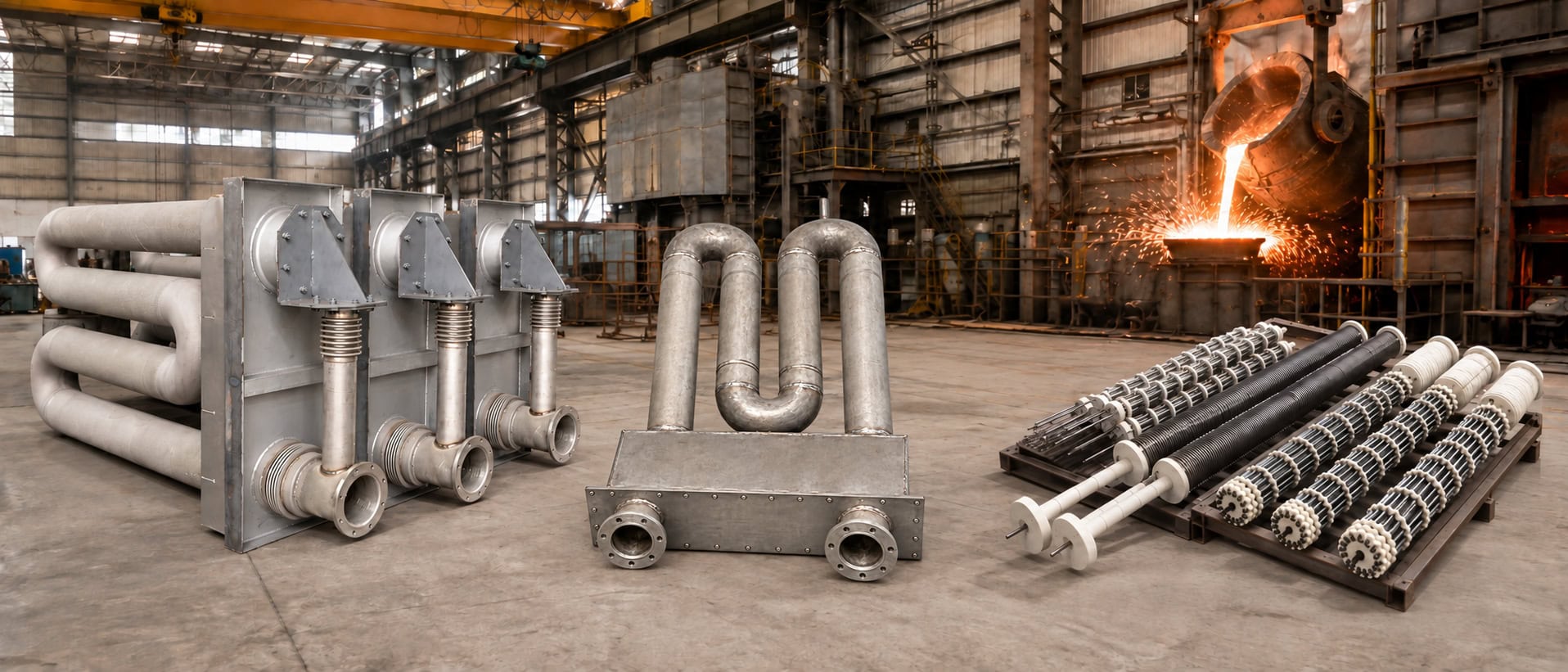
Production context: The component reference should be read together with the manufacturing and inspection context behind the furnace application.

RFQ information checklist
For a useful first review, send the drawing or used sample, key dimensions, furnace type, load, operating cycle, visible failure evidence and any required inspection points. Final material and acceptance decisions are confirmed for the specific project.
Related Radiant Tube Resources
Use these technical guides when specifying, inspecting or replacing radiant tubes for an industrial furnace:
- Radiant Tubes for Annealing and Heat-Treatment Furnaces
- Straight, U-Type or W-Type Radiant Tubes
- Radiant Tube Failure: Cracking, Sagging and Oxidation
- Radiant Tube Installation and Connection Inspection Guide
- Industrial Furnace Radiant Tubes: Material and Service Life
Related ECOOSUN Products
Information for a Faster Quotation
Provide alloy grade or service conditions, straight/U/W form, tube dimensions, burner and connection details, operating temperature, furnace zone, quantity, drawing or used sample, and inspection requirements.
Request a Custom Quote · Send Your Drawing · WhatsApp ECOOSUN

 +44 7419 144346